Key takeaway
Most MedTech AI pilots stall after the model works. Why the missing pieces are a clinical decision, a data owner and a route to approval, and the seven-element operating model one Head of Digital Platforms proposed.
Short answer: Most MedTech AI pilots stall after the model works, not before. They fail because no one defined which clinical decision the AI changes, no one owns the data it depends on, and no one mapped the route to regulatory approval and ongoing monitoring. The fix is organisational: frame the decision and workflow before funding, build the data and platform connections in, and run a repeatable, risk-based governance lifecycle. Then track value, adoption and risk together.
The model is rarely the problem. Deloitte's 2026 survey of 378 life sciences and healthcare leaders found that stalled pilots are usually blocked by production requirements "such as integration, security reviews, compliance, and monitoring", not by accuracy. The same pattern shows up outside healthcare: MIT's 2025 analysis of 300 public AI deployments concluded that the gap between the 5% of pilots that scale and the rest is a "learning gap" in how organisations adopt tools, not a technology gap.
Hammarlund's own example makes it concrete. His team built AI support for ventilator weaning, the decision about when a patient in intensive care can breathe without the machine. In his words, the pilot had "Promising results on offline, masked data", but "no reliable link to patient records", "no agreed data owner" and "no workflow for reviewing or acting on insights". It stalled. His conclusion: "What scaling needs beyond the model" is "Value and workflow, trusted data, risk-based governance".
The clinical literature tells the same story. A December 2025 study in Frontiers in Medicine trained a model on 5,202 ICU patients to predict extubation success and reached an AUC of 0.861, against 0.637 for the standard bedside index. Its authors still called for prospective and external validation before use, and built a prototype for exactly that. A good retrospective model is where the work starts, not where it ends.
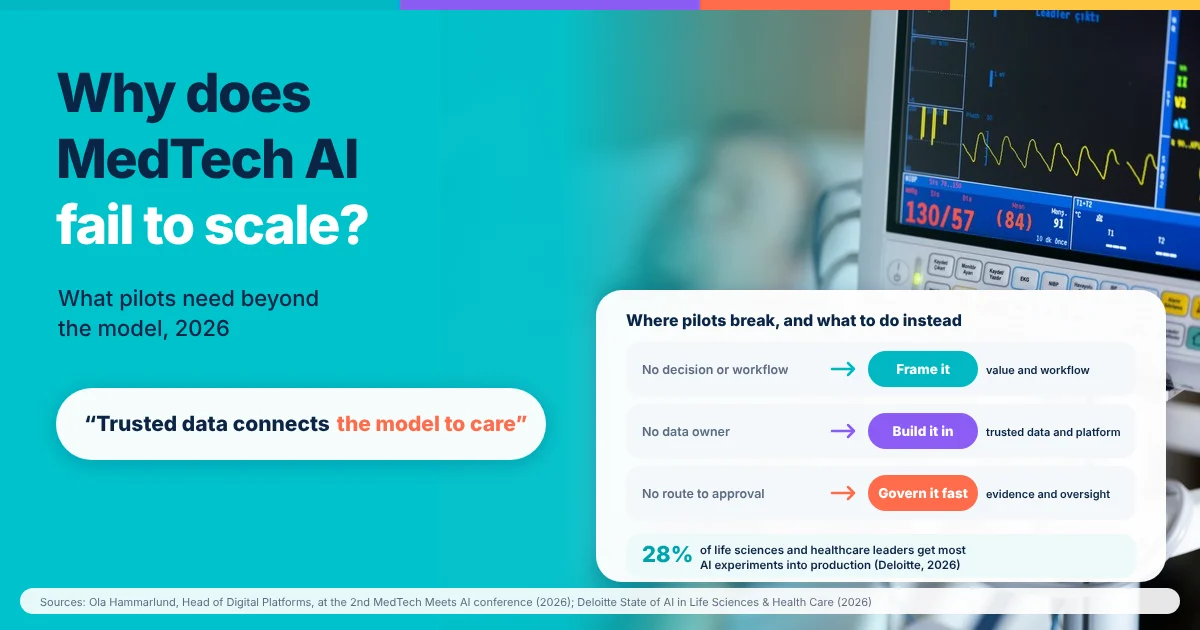
At the 2nd MedTech Meets AI conference in Barcelona on 14 October 2026, Ola Hammarlund, Head of Digital Platforms at Getinge, set out why pilots break and what to do instead. His framework has three moves, each answering one failure:
"Frame it" where there is "No decision or workflow"; "Build it in" where there is "No data owner"; "Govern it fast" where there is "No route to approval".
Ola Hammarlund, Head of Digital Platforms, Getinge, 2nd MedTech Meets AI, October 2026
Frame it. Before any funding, answer three questions from his presentation: "Which decision will AI change?", "Who owns the intended use and value?" and "How will people act and give feedback?" If nobody can name the decision, there is nothing to scale.
Build it in. The model needs a digital backbone: connected devices with "Reliable telemetry", trusted data that is "Governed, fit-for-purpose", integration through "APIs and shared data contracts", a clinical workflow that delivers "Insights people can act on", and patient records where "Decisions and outcomes" are captured. As he summed it up: "Trusted data connects the model to care".
Govern it fast. Governance should be a repeatable lifecycle, not a one-off review: idea intake, risk classification, evidence and validation, deployment readiness, monitored operation, and change control and reassessment, where "Reassessment findings inform the next idea".
Hammarlund's presentation proposed seven elements for scaling, each tied to what it ensures:
Ownership is shared across six functions, R&D and product, clinical, quality and regulatory, IT and digital, cybersecurity, and service and commercial, under one governed operating model. The glue is at the top: "Executive sponsorship connects ownership, funding and decisions".
That matches what regulators now expect. The IMDRF's Good Machine Learning Practice principles, finalised in January 2025, add explicit infrastructure for "deployment, monitoring, and maintenance" to the original ten principles (RAPS). The FDA's draft guidance on lifecycle management for AI-enabled device software (January 2025) asks sponsors to plan for performance monitoring and change control from the start. And the UK's MHRA, after the second phase of its AI Airlock sandbox, reported in June 2026 that "real-world performance can be difficult to replicate in controlled settings", and that for large language models "device behaviour can shift significantly without explicit design changes".
Hammarlund's answer is a leadership scorecard that puts "Value, adoption and risk in one view": cost, revenue, time saved and clinical outcomes; use in eligible workflows and time to first live decision; drift from validated performance; deployments with a reviewed risk classification; and initiatives with a named value owner. His instruction: "Track benefit alongside use, quality and oversight".
The gap this fills is real. A 2025 Health Affairs survey of more than 2,400 US hospitals found that 65% used predictive models, but only 61% had evaluated accuracy on their own data and 44% had evaluated them for bias. Stanford's monitoring framework for deployed clinical AI, published as a preprint in December 2025, argues that performance, impact and system integrity all need routine checks, and notes that monitoring is costly for resource-limited systems. Hospitals are already wary: ECRI put misuse of AI chatbots at the top of its 2026 list of health technology hazards.
For the measurement side of AI projects, see How Do You Evaluate Generative AI in Pharma? 2026 Guide and, for the regulatory path, When Does the EU AI Act Apply to Medical Devices?
Hammarlund closed with three commitments:
None of them is about the model. All of them are decisions leaders can take this quarter.
For how this plays out in surgery, see How Is AI Used in the Operating Room? 2026 Guide.
These topics will be on the agenda at the next MedTech Meets AI conference.
Because scaling depends on things outside the model: a defined clinical decision and workflow, owned and governed data, integration with patient records and devices, and a repeatable route through validation, approval and monitoring. Surveys in 2025 and 2026 point to integration, security, compliance and monitoring as the main blockers.
A set of shared rules and roles for taking AI from idea to monitored operation. Hammarlund's version has seven elements: value and intended use, workflow adoption, trusted data, platform integration, evidence and lifecycle, risk-based governance, and a balanced scorecard, owned across R&D, clinical, quality and regulatory, IT, cybersecurity and commercial functions.
After the Digital Omnibus on AI, which entered into force on 27 July 2026, the high-risk obligations for AI systems that are medical devices or their safety components apply from 2 August 2028, a year later than first planned.
The FDA does not publish a total, but a September 2026 analysis of its AI-enabled device list counted 1,614 devices, most of them in radiology, with 335 added in 2025.
Value (cost, revenue, time saved, clinical outcomes), adoption (use in eligible workflows, time to first live decision), quality (drift from validated performance), risk (deployments with reviewed risk classification) and portfolio (initiatives with a named value owner).
MedTech Meets AI, organised by UBIQ Events, brings together MedTech R&D, clinical, quality, regulatory and digital leaders to discuss AI in devices, from pilots to production.


