Key takeaway
AI in surgery today means better images, workflow recognition and OR coordination, not robot surgeons. What the 2025–2026 evidence shows, with lessons from KARL STORZ and J&J MedTech.
Short answer: In 2026, AI in the operating room mostly works in the background. It enhances endoscopic and surgical images in real time, recognises the phases of an operation from video, highlights anatomy such as nerves and ureters, and coordinates the room by detecting events and updating schedules and records. It does not operate on its own. The evidence shows AI can help surgeons see and recognise more, but few tools have yet proven better patient outcomes, and the surgeon stays in charge.
Robotic surgery is one reason the opportunity is growing. Surgeons performed about 3,153,000 procedures with da Vinci systems in 2025, up about 18% on 2024, and Intuitive expects procedures to grow a further 13% to 15% in 2026. Every robotic or endoscopic procedure produces video and device data that AI can learn from.
Most AI in the OR sits inside equipment surgeons already use. The main uses are:
The evidence is growing fast, but it is strongest on recognition, not outcomes. A 2026 meta-analysis in npj Digital Medicine pooled 146 studies of AI in surgical and interventional video. At peak performance AI had "significantly greater sensitivity and comparable specificity" than unassisted clinicians, and clinicians assisted by AI beat clinicians alone on both measures.
Outcome data is thinner. In a randomised trial at three Japanese hospitals, 90 patients had laparoscopic colorectal surgery with or without AI overlays of the ureter and nerves. Surgeons recognised the target structures faster and reported slightly less fatigue, but patient outcomes did not improve. A December 2025 review of 188 surgical scene understanding studies found most relied on small, single-centre datasets (70.7%) and only 5.9% addressed clinical translation.
The clearest operational result so far comes from the room rather than the patient. At Houston Methodist, camera-based AI in a 15-room cardiothoracic suite tracked 5,417 cases over 16 months and was linked to about 25 more cases a month, a 7% rise compared with 11 other sites.
At the 2nd MedTech Meets AI conference in Barcelona in October 2026, Sebastian Koller, Executive Director Advanced Technology at KARL STORZ, traced the digital OR from routing images to understanding situations. Each generation of the OR, he argued, crossed a boundary: connecting video, integrating devices, digitising workflow and now assisting the team. In his presentation, he put the next step simply:
"The Next Boundary is not the wall of the operating room. It is the gap between information and understanding"
Sebastian Koller, KARL STORZ, 2nd MedTech Meets AI, October 2026
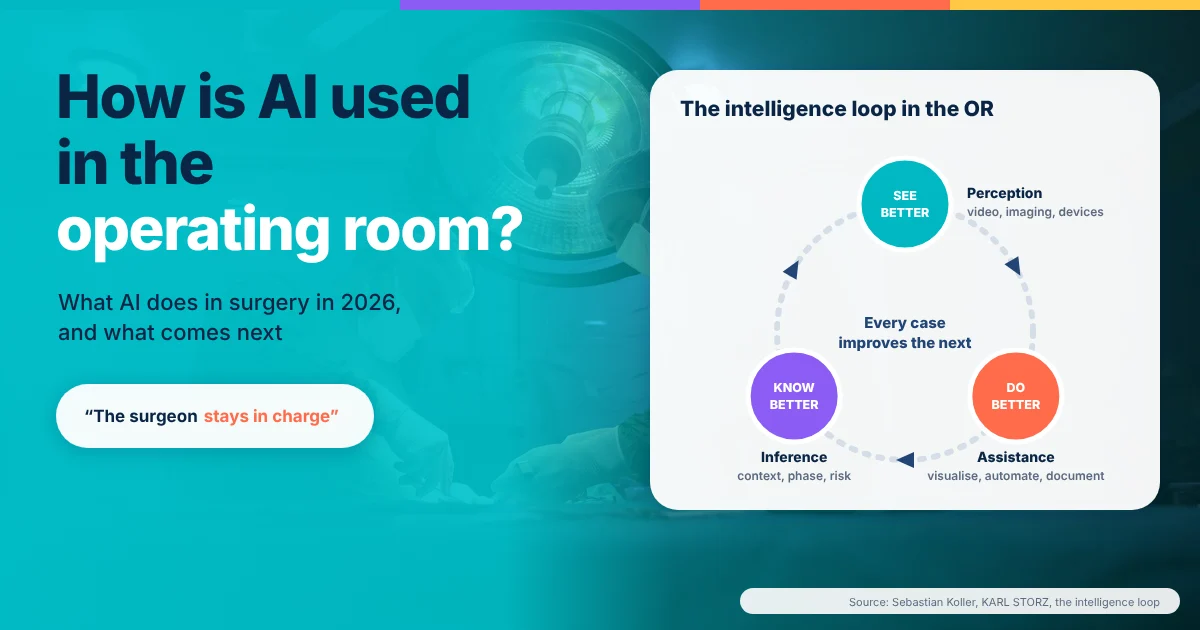
His framework is an intelligence loop of perception (video, imaging, devices, the room), inference (context, phase, risk, intent) and assistance (visualise, automate, document), summed up as "see better, know better, do better". Because every case can feed the next, he promised in his presentation that "Every case improves the next".
A year earlier, at MedTech Meets AI 2025, Jamie Roots, Global Head of Portfolio Architecture at Johnson & Johnson MedTech Digital, described the shift as "from solo to shared intelligence": from decisions resting on one surgeon's experience to AI that learns from many procedures. He listed five capabilities already in research labs: image segmentation, surgical scene understanding, automated report generation, surgical workflow analysis and analysis of surgical team interactions.
Not soon, and the industry is not aiming for it first. Koller described six levels of surgical intelligence: 0 manual, 1 assist, 2 partial, 3 conditional, 4 high and 5 full. Most tools in clinical use today sit at the lower levels: they observe, recognise selected situations and support single steps. In his speech, he was clear about who stays in control: "The surgeon leads. Intelligence makes sure they never operate alone."
Research is moving faster than the clinic. In July 2025, a Johns Hopkins team reported in Science Robotics that its SRT-H robot, trained on videos of surgeons, carried out a 17-task phase of gallbladder removal on a lifelike model with 100% accuracy, while responding to spoken corrections from the team. It was slower than an expert surgeon, with comparable results, and the test was on a model, not a patient.
That matters because the pressure on surgical teams is real. A 2026 study of 224,629 US surgeons found that 9.7% left active clinical practice within eight years. AI that takes routine coordination and documentation off the team may help more, sooner, than AI that tries to take over clinical decisions.
Both speakers pointed to the same barriers, and none of them is the algorithm:
Koller closed his presentation with one line: "NO ONE BUILDS THE INTELLIGENT OR ALONE".
In the EU, AI that is part of a medical device falls under both the Medical Device Regulation and the AI Act. Regulation (EU) 2026/1744, in force since 27 July 2026, moved the AI Act's high-risk obligations for AI built into regulated products such as medical devices to 2 August 2028. We explain what that means in When Does the EU AI Act Apply to Medical Devices?.
In the US, the FDA's list of AI-enabled medical devices reached 1,614 authorised devices in its September 2026 update, according to an analysis by Complizen. Radiology accounts for about three quarters of them, and surgery is still a small share.
Header photo: mohamad azaam on Unsplash.
AI in surgery enhances surgical images, recognises procedure phases and instruments from video, highlights anatomy to protect, coordinates the operating room by detecting events and updating records and schedules, and supports training and documentation. The surgeon remains in control.
No. Current AI tools assist surgical teams at low levels of autonomy, for example by recognising situations or supporting single steps. Fully autonomous surgery is not in routine clinical use.
No. In robotic surgery, the surgeon controls the robot's instruments from a console. AI is software that interprets video and data, for example to recognise anatomy or procedure phases. AI can be added to robotic systems, but most robotic procedures today are fully controlled by the surgeon.
The evidence so far is strongest for recognition and efficiency. A 2025 randomised trial found AI overlays helped surgeons identify anatomy faster but did not improve patient outcomes, so larger outcome trials are still needed.
A digital operating room connects video, devices and information systems so data can be routed, controlled, recorded and analysed. AI adds the ability to interpret that data and assist the team in real time.
Under Regulation (EU) 2026/1744, the AI Act's high-risk obligations for AI in regulated products such as medical devices apply from 2 August 2028.
MedTech Meets AI, organised by UBIQ Events in Barcelona, brings together MedTech, regulatory and digital leaders to discuss AI in devices, surgery, diagnostics and quality systems.


