Key takeaway
Public benchmarks don't tell you if a generative AI system is safe to use in pharma. How to evaluate the whole system against your own goals, with lessons from MSD's Filip Rais and the 2026 EMA–FDA principles.
Short answer: Evaluate the whole system in its real use, not the model on a public leaderboard. Start from the business goal, break the workflow into steps, pick domain metrics for each step, and test against a realistic dataset that includes edge cases. Then keep evaluating after launch, because generative AI is probabilistic and its behaviour drifts. Regulators in the EU and US now expect exactly this: a defined context of use, risk-based performance assessment and lifecycle monitoring.
Because they measure the model, not your use of it. Public benchmarks are useful as a rough guide, but three problems limit them. They saturate: top models now score so high that tests stop telling them apart. They can be contaminated: if test questions end up in a model's training data, the score overstates its ability. And they are generic: a high score on maths or coding questions says little about how a system will summarise a safety case or screen scientific literature.
The 2026 AI Index from Stanford HAI found AI capability is "outpacing the benchmarks designed to measure it". Its medicine chapter made the same point for healthcare: LLMs have passed most clinical reasoning benchmarks, but strong scores "have yet to translate reliably to measurable clinical outcomes".
At the 2nd Pharma Meets AI conference in Barcelona in April 2026, Filip Rais, Director of Technical Architecture at MSD, gave a practical guide to evaluating generative and autonomous AI in regulated industries. He called the problem the "benchmark illusion", and his conclusion was blunt:
"No combination of public benchmark scores can reliably predict model performance!"
Filip Rais, MSD, 2nd Pharma Meets AI, April 2026
The theme of his presentation was that what matters is how the whole system behaves, not the model or a single metric. As he put it: "In AI systems, the evaluation is the product."
Traditional pharma software is deterministic. The same input gives the same output, so validation works like an inspection: test once, sign off, move on. Generative AI is probabilistic. Outputs vary, so teams measure confidence, accuracy and hallucination rates, compare outputs for similarity, and use human ratings or another model as a judge.
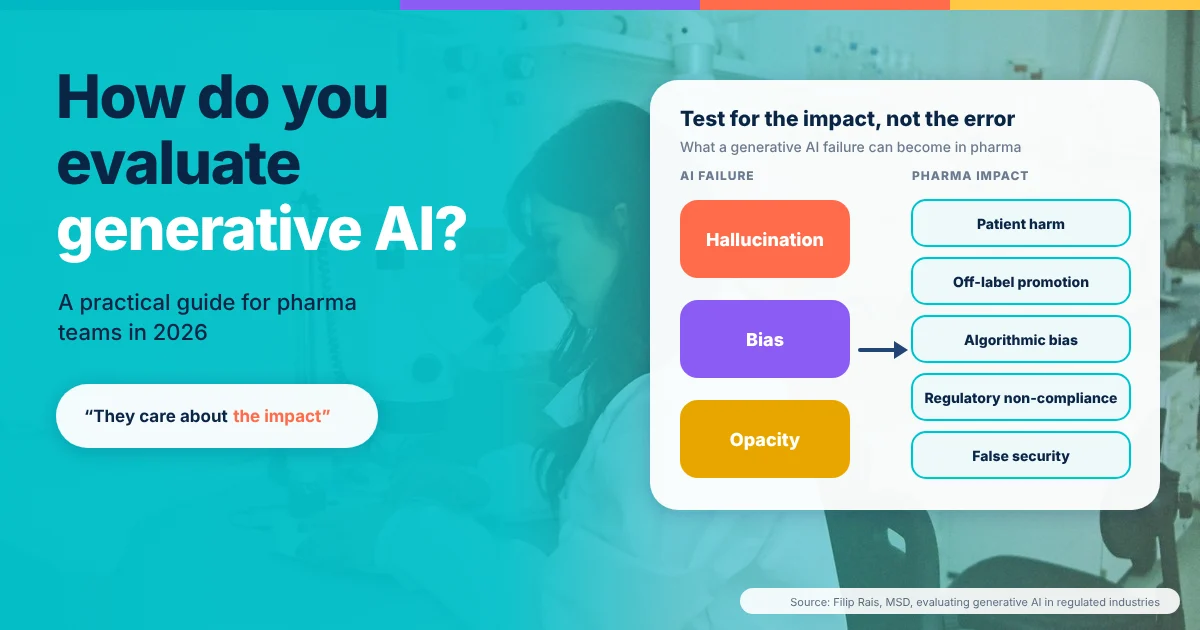
Rais linked technical failures to the consequences that matter in pharma. Hallucination, bias and opacity can lead to patient harm, off-label promotion, discrimination or regulatory non-compliance. In his words: "The regulator doesn't care about the cause - they care about the impact." So evaluation should test for what the company will be held accountable for, not only for what engineers call the problem.
The risk is measurable. In a 2025 npj Digital Medicine study of LLM-generated clinical summaries, 1.47% of sentences contained hallucinations and 3.45% of transcript sentences were omitted. Of the hallucinations, 44% were classed as major, meaning they could affect patient care.
Rais set out a three-part approach, adapted from the Goal, Question, Metric method used in software engineering:
Rais named several traps:
The direction is the same on both sides of the Atlantic: define the context of use, match the evidence to the risk, and keep monitoring.
For how governance helps AI move from pilot to production, see Why Do Most Pharma AI Projects Never Leave the Pilot Stage?.
Header photo: Diana Hauan on Unsplash.
Define the business goal and context of use, break the workflow into steps, choose domain metrics for each step, test the whole system on a realistic dataset that includes edge cases, and keep monitoring performance after launch.
Only as a starting point. Benchmarks saturate, can be contaminated by training data and test generic skills, so they cannot predict how a system will perform on a specific pharma task.
It is the use of one AI model to score the outputs of another. It helps evaluation scale, but AI judges can be brittle and biased, so their results need checking against human experts.
It depends on the task and system. One 2025 study of clinical note summaries found hallucinations in 1.47% of sentences, with 44% of those potentially affecting patient care.
FDA's January 2025 draft guidance proposes a seven-step, risk-based credibility assessment based on the AI model's context of use, model influence and decision consequence.
Pharma Meets AI, organised by UBIQ Events in Barcelona, brings together pharma leaders to discuss AI governance, evaluation, agentic AI and data foundations.


