Key takeaway
Congresses take a large share of pharma marketing budgets and draw record crowds, yet most interactions go uncaptured. What HCPs want from congresses in 2026, why insight capture fails, the Evidence Flywheel framework from our stage, and what EFPIA and national codes allow.
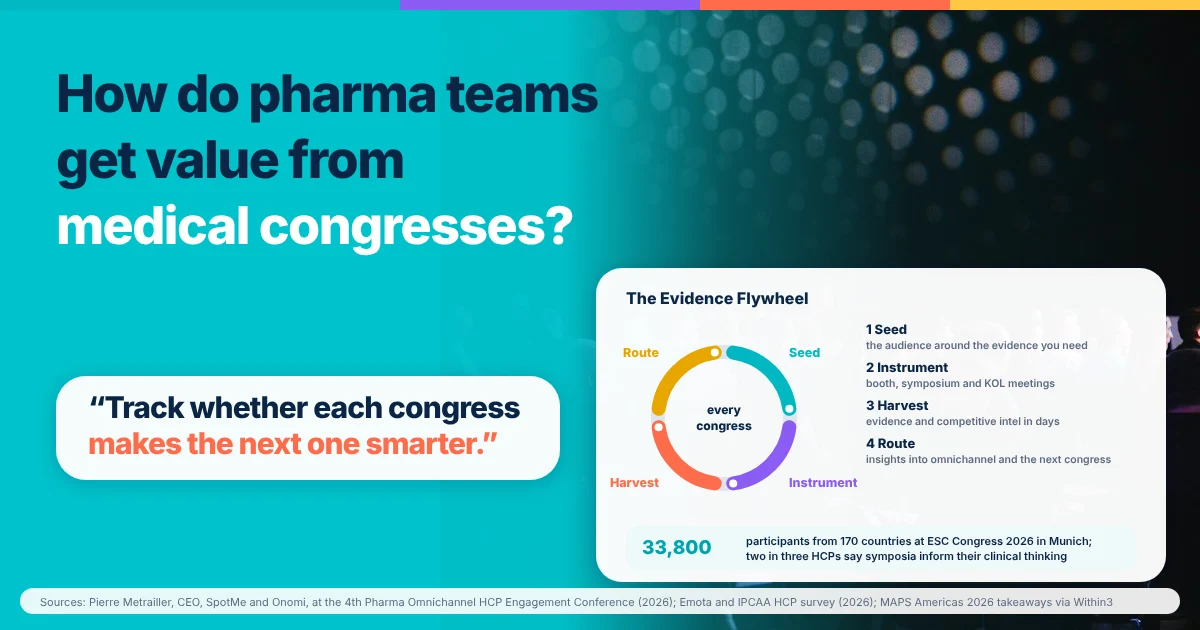
Short answer: By treating a congress as a source of evidence rather than an event. Congresses are the single most expensive activity in most pharma marketing budgets, and HCPs still rate them highly: two in three say symposia inform their clinical thinking. The value is lost afterwards, when conversations at the booth, in symposia and in KOL meetings stay in notebooks and inboxes. On our stage, Pierre Metrailler proposed a four-step "Evidence Flywheel": seed the right audience, instrument every scientific exchange, route insights into action within days, and measure whether each congress makes the next one smarter. Everything has to fit inside the EFPIA Code, which caps hospitality and bans entertainment.
Metrailler opened with a contrast that most commercial and medical leaders will recognise. In his words, congresses are "medical/commercial highest-value activity" and "also its least instrumented". His estimate was that around 3% of pharma revenue typically goes on events and congresses, which for a $40 billion company is $1.2 billion a year. An agency survey published in 2024 put congresses at 30 to 40% of the annual marketing budget. Yet, as his presentation put it: "Most congress interactions go uncaptured. Insights remain in personal notebooks, email threads, and tribal knowledge."
The data on medical affairs insight management supports him. A 2026 peer-reviewed survey of 1,023 medical affairs professionals in 63 countries found that only 40% say their organisation measures the impact of medical science liaisons, 67% find MSL performance difficult or very difficult to measure, and 76% struggle to define the quality of MSL activities. Takeaways published from the MAPS Americas 2026 meeting put the structural problem bluntly: 83% of companies lack formal validation rubrics for insights, and more than 15 steps separate a field observation from strategic impact. An older industry survey (2023) found 79% of medical affairs teams use less than half of the data they collect.
The money and the attention are at the congress. The system for learning from it is not.
The demand side is healthy. The Emota and IPCAA survey of 251 HCPs across the US and five European countries, published in February 2026, found 66% very satisfied with congresses and two in three saying the insights from symposia inform their clinical thinking. The same survey's headline was about what happens afterwards: HCPs expect content after the event, not just at it. Sermo's February 2026 survey of 499 physicians in North America and Europe ranked scientific symposia and conferences among the most authoritative sources for 55% of respondents, second only to publications, and found a near-even split between those who prefer in-person meetings (46%) and webinars or virtual formats (43%). The role of the people on the stand is shifting too: in a vendor survey of 75 US and European KOLs in April 2026, 40% said they would ask an AI tool first when seeking scientific information, yet nearly 75% still want to talk to an MSL for insight into a company's pipeline, and 71% prefer an MSL for the company's scientific position and complex cases. Oliver Wyman's November 2026 review of HCP engagement, drawing on a survey of more than 6,000 physicians in 13 countries, concluded that hybrid engagement is now the norm and that the quality of pharma-physician interactions has declined. Congresses are one of the few places where quality can still be high.
Attendance figures tell the same story. The European Society of Cardiology reported 33,800 participants from 170 countries at ESC Congress 2026 in Munich, up from 33,300 in Madrid the year before. ASCO 2026 in Chicago drew more than 40,000 oncology professionals, and the venue operator for ESMO 2026 in Madrid (23 to 27 October) reported close to 40,000 participants and a 30,000 square metre exhibition. EASD 2026 in Milan thanked more than 16,000 participants, on site and online, and the American Society of Hematology offers in-person, virtual and on-demand attendance for its December 2026 meeting in New Orleans. Hybrid is now the default format, which means the congress audience is bigger than the hall and the follow-up has to be digital. A vendor survey of 78 oncologists who attended ASCO 2026 found 86% saying the data presented would change their treatment approach in clinic, which is the kind of signal a sponsor wants to capture rather than infer.
We looked at how HCPs choose their sources in KOL vs DOL: What Is a Digital Opinion Leader in Pharma?.
At the 4th Pharma Omnichannel HCP Engagement Conference in Barcelona in March 2026, Pierre Metrailler, CEO of SpotMe and Onomi, a congress-engagement technology company, mapped the congress ecosystem as three "evidence engines": KOL engagement (advisory boards, speaker programmes, standalone meetings), field and staff-based insight touchpoints (booth, MSL visits, field-led meetings) and symposium or scientific exchange touchpoints (satellite symposia, webinars, HCP portals). Each generates evidence; almost none of it is captured in a structured way.
His answer was a four-step framework:
"The Evidence Flywheel: a new framework for making congresses your strategic engine"
Pierre Metrailler, CEO, SpotMe and Onomi, 4th Pharma Omnichannel HCP Engagement Conference, March 2026
He illustrated the current state with a slide of spreadsheets named after congresses and countries sitting beside the CRM and the medical export. Most readers will recognise their own folder.
Metrailler's proposed metrics were KOL and HCP depth, insight quality, and time from evidence to decision. Those are better than the usual ones. IQVIA's 2025 commentary on congress impact noted that most teams have limited hard data beyond attendance, and the industry's own surveys suggest that measuring knowledge gain or practice change is rare. The Cureus survey shows the same gap on the medical side: 61% of medical affairs professionals say quantitative standards do not reflect MSL value, which is why the field has drifted towards counting activities instead of outcomes.
A practical scorecard for a congress has four layers. Reach: who was met, against the target list built before the event. Exchange: how many structured insights were captured, by channel, and how many passed a quality check. Action: how many insights triggered a follow-up, a content change or a decision, and how long that took. Learning: what changed in the plan for the next congress as a result. For how to connect this to the wider engagement data stack, see How Can Pharma Commercial Teams Turn Data into Decisions with AI? and, on measuring experience rather than reach, How Do You Measure HCP Experience, Not Just Reach?.
The commercial upside has to sit inside the compliance frame. The 2026 consolidated EFPIA Code of Practice limits hospitality to travel, meals, accommodation and genuine registration fees (Article 10.04), caps meals at the host country's threshold (10.05) and bans entertainment (10.08). No payment may compensate HCPs merely for time spent (13.01), and transfers of value must be disclosed within six months of the end of the reporting period (22.01). From the 2026 disclosure of 2025 transfers, a methodological note is mandatory.
EFPIA and IPCAA's July 2025 rules for medical congresses add that industry activities should be a minor part of the programme, with the scientific programme making up as much as 95%, and that international congresses need a positive e4ethics assessment before companies can support them. National codes keep moving: Ireland's IPHA code raised its meal threshold to EUR 90 from June 2025, Greece's SFEE code took effect in April 2026, Spain caps meals at EUR 70 and requires meetings of 20 or more HCPs to be notified to Farmaindustria, and Sweden moves to a searchable disclosure database from 2027 (EFPIA Code Report 2025). Disclosed transfers keep rising. In the UK, total disclosed value rose 17% to GBP 813.3 million in 2024. In Spain, Farmaindustria's June 2026 release put 2025 industry collaborations at EUR 833 million, up 6%, including EUR 252 million for continuing medical education. The bigger change is coming from Brussels: the Council of the EU adopted the new pharmaceutical package on 28 September 2026, and EFPIA's 2025 code report says it expects to amend the Code on the definition of a healthcare professional and on comparative advertising once the legislation is published.
For the instrumentation Metrailler describes, the practical point is consent and purpose: capturing a conversation at a booth in a CRM is data processing about an identifiable HCP, and the same GDPR rules that govern omnichannel apply.
These topics will be on the agenda at the Pharma Commercial Innovation Summit in Valencia on 24–25 November 2026, organised by UBIQ Events.
No regulator publishes a global total. An agency survey published in 2024 put congresses at 30 to 40% of a pharma company's annual marketing budget. In Spain, the industry disclosed EUR 252 million for continuing medical education in 2025, including EUR 137 million to healthcare organisations for meetings and congresses. A speaker at our conference estimated around 3% of revenue, or about $1.2 billion a year for a $40 billion company.
Yes. In a February 2026 survey of 251 HCPs in the US and Europe, 66% were very satisfied with congresses and two in three said symposium insights inform their clinical thinking. ESC, ASCO and ESMO each drew well over 30,000 participants in 2026.
A structured observation from an interaction with an HCP, such as a question, an objection, an unmet need or competitive intelligence, recorded in a way that can be validated, aggregated and acted on. Surveys in 2026 suggest most companies lack formal rubrics for validating insights.
Move beyond attendance and leads to four layers: reach against a target list, structured insights captured and validated, actions triggered and the time they took, and what changed in the plan for the next congress.
Hospitality limited to travel, meals, accommodation and registration fees, meal caps set by each country (EUR 70 in Spain, EUR 90 in Ireland), no entertainment, no payment for time spent, and disclosure of transfers of value within six months of year end.
The Pharma Commercial Innovation Summit and the Pharma Omnichannel HCP Engagement Conference, both organised by UBIQ Events, bring together commercial, medical and omnichannel leaders from across Europe.


