Key takeaway
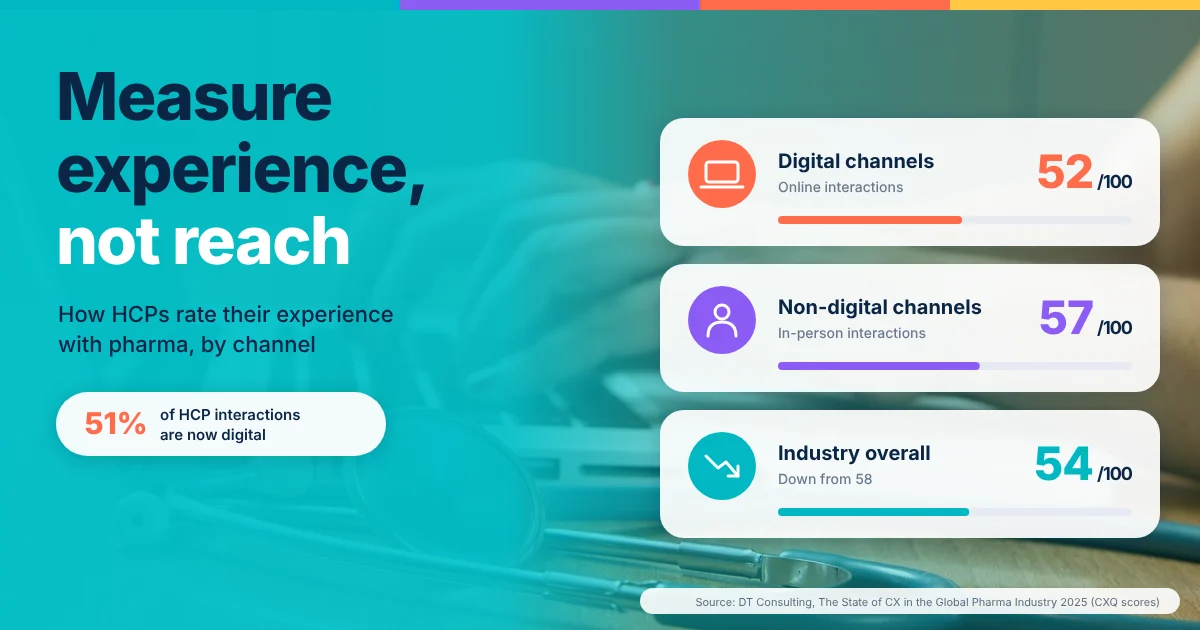
Most HCP interactions are now digital, yet digital experience scores lag face-to-face. Why reach and open rates mislead, and how pharma can measure what HCPs actually feel.
Short answer: Stop treating reach, frequency and open rates as proof of engagement. Measure experience in two tiers: quick in-the-moment feedback (CSAT, effort, thumbs up or down) after each interaction to fix friction fast, and brand-level NPS over time to track trust and advocacy. Then use AI to read the open comments, because scores tell you what happened and the comments tell you why.
Pharma grew up counting what is easy to count. Field teams report coverage and call frequency. Digital teams report opens, clicks and time on site. None of these say whether a doctor found the interaction useful, or changed anything because of it.
Three traps stand out. Coverage and frequency measure activity, not influence. Email open rates of 80% or more are often false positives, because Apple Mail Privacy Protection loads messages automatically and bots trigger opens. And long time on a website can mean the opposite of interest: an HCP who spends 20 minutes looking for clinical data is probably frustrated, not engaged.
At the 4th Pharma Omnichannel HCP Engagement Conference in March 2026, Ufuk Balci, Head of Business Excellence at GSK Netherlands, made the case for measuring experience instead of activity. He presented in a personal capacity, using publicly available sources. His diagnosis was blunt:
"Pharma currently counts what is easy to measure, not what is meaningful for behaviour change."
Ufuk Balci, 4th Pharma Omnichannel HCP Engagement Conference, March 2026
He also pointed out what traditional measurement misses. Episodic market research and retrospective sales analysis are slow, expensive for local teams, and reflect the past rather than what HCPs are experiencing now.
Balci's toolkit uses five simple questions, each asked at the right moment:
Source: Ufuk Balci, "Beyond Reach" (March 2026).
Balci proposed a two-tier architecture. At the top, strategic relationship health tracks trust, advocacy and loyalty over time with brand-level NPS, to predict market share and guide strategy. At the base, activity-level CX captures in-the-moment feedback right after each interaction, with CSAT, effort scores, smilies or thumbs, to remove friction and correct journeys quickly.
The two tiers answer different questions. NPS tells leadership whether the relationship is getting stronger. CSAT tells the channel owner which webinar, email or web page needs fixing this month. An example dashboard in his talk showed why both matter: face-to-face visits scored consistently high, while website scores sat far lower, a gap that reach metrics would never reveal.
A score of 6 out of 10 says something went wrong, not what. Balci's answer is to always add an open question and let AI do the reading. Large language models can sort thousands of comments into themes such as professional scepticism, administrative relief or digital frustration, with the emotional nuance kept.
He went further, describing journeys that "self-heal": when low CSAT or erratic clicks signal friction, an automated test serves a pre-approved alternative version of the content in real time, instead of waiting for a quarterly review. The same language models can scan rep notes and call transcripts for knowledge gaps, and combine social listening with CRM notes to spot shifts in clinical practice before they appear in sales data.
Header photo: National Cancer Institute on Unsplash.
HCP experience is how healthcare professionals perceive every interaction with a pharmaceutical company, from rep visits and webinars to emails, websites and medical information. It is measured with satisfaction, effort and recommendation scores, not with reach or frequency.
Apple Mail Privacy Protection preloads emails, and security bots open links automatically, so many recorded opens never involved a person. Clicks, replies and direct feedback are more reliable signals.
CSAT measures satisfaction with a single interaction, straight after it happens. NPS asks how likely an HCP is to recommend the company or brand to a colleague, and tracks the overall relationship over time.
DT Consulting's 2025 research found that HCPs with an excellent experience are 1.8 times more likely to prescribe, and Precision AQ (formerly Across Health) has linked higher brand-level NPS to market share growth over the following 12 months.
The Pharma Omnichannel HCP Engagement Conference, organised by UBIQ Events, brings together pharma commercial, medical and digital leaders to discuss omnichannel strategy, HCP experience, AI and engagement measurement.


