Key takeaway
Optichannel means choosing the few channels that help one healthcare professional reach one goal. What we heard on our stage, a loss-of-exclusivity case, the evidence on activity versus value, and how to measure what matters.
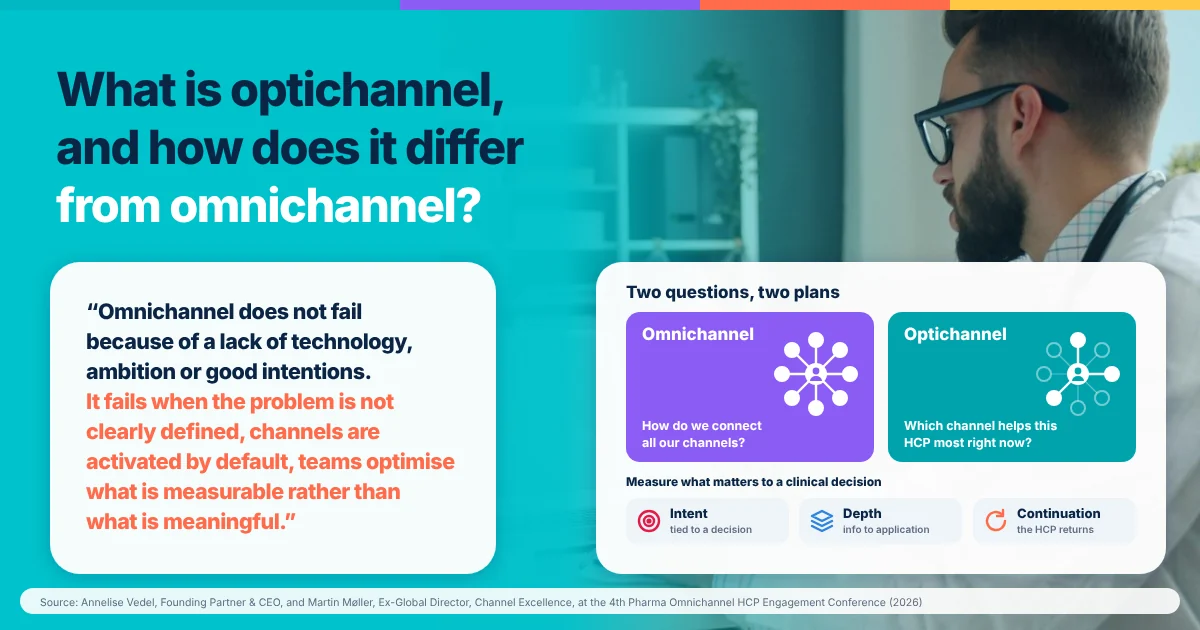
Short answer: Optichannel means choosing, for each healthcare professional and each goal, the few channels most likely to help at that moment. Omnichannel aims to connect every channel around the customer's journey. At the 4th Pharma Omnichannel HCP Engagement Conference, Annelise Vedel, Founding Partner and CEO of Aetheon Consulting, and Martin Møller, former Global Director, Channel Excellence at Novo Nordisk, explained why the difference matters: "Omnichannel does not fail because of a lack of technology, ambition or good intentions. It fails when the problem is not clearly defined, channels are activated by default, teams optimise what is measurable rather than what is meaningful." The term is new and it is contested. Some analysts see it as a fresh label for an old execution problem, which is a fair warning: the label changes nothing unless the planning starts from the problem the healthcare professional actually has.
Vedel and Møller gave their keynote, "From Omnichannel Ambition to Measurable HCP Impact", in Barcelona in March 2026, and they opened with two lists. On one side stood what healthcare professionals say they want from pharma: relevancy, credibility, clinical value and decision support. On the other stood what pharma mostly delivers: volume, orchestration, activation and reach. Their conclusion from the comparison was one sentence, "Activity is increasing faster than the perceived value", and they followed it with a question to the room: "Raise your hand, if you have ever started a planning process without HCPs knowing the problem?"
They then showed what that looks like in practice, with the case of a brand approaching loss of exclusivity. The commercial objective was the obvious one, to maximise sales before generics entered the market, and the first plan followed from it. The team wanted to drive more patients to physicians, increase prescriptions before the patent expired, and activate the awareness and education material it already had. It was a plan built around channels and assets. When the team looked at the data, the plan turned out to be aimed at a problem that did not exist. Physicians were already good at identifying the right patients, and patients were being started on treatment. The weakness came afterwards: prescriptions were not consistently refilled, patients were not titrating to the right dose, and so the treatment was not delivering its full effect.
The response changed completely once the problem was defined. In place of more awareness, the team supported the onboarding of patients and educated physicians on titration. The tactics were modest: a simple patient website with onboarding guidance, patient case videos, an onboarding programme for physicians and a version of the patient story told for a clinical audience. Fewer channels were used than in the original plan, and each had a job. From cases like this one, the speakers drew their central lesson:
"Omnichannel does not fail because of a lack of technology, ambition or good intentions. It fails when the problem is not clearly defined, channels are activated by default, teams optimise what is measurable rather than what is meaningful."
Annelise Vedel, Founding Partner & CEO, Aetheon Consulting, and Martin Møller, Ex-Global Director, Channel Excellence, Novo Nordisk, 4th Pharma Omnichannel HCP Engagement Conference, March 2026
Their remedy is a sentence that every plan should be able to complete before any channel is chosen: "If this works, the HCP will be better able to … and that matters because". The first blank names a capability that the physician gains, such as titrating a patient with confidence. The second names why it matters for the patient. If a team cannot fill in both, it is planning actions without a goal, which is how the brand in the case nearly spent its last protected years promoting awareness that already existed.
For the brand in the case, the sentence might have read as follows (our wording, not theirs): if this works, the physician will be better able to bring a new patient to the right dose in the first months of treatment, and that matters because the medicine only delivers its effect at that dose. Once the sentence is written, most of the original plan falls away, because an awareness campaign does nothing for titration. The speakers condensed the method into four steps:
"Start with the problem, not the platform. Start with the goal, not the action. Define the change first. Then design the actions that support it. Design the optichannel. Choose the few channels that actually help the HCP move forward. Measure meaningful engagement. Track intent, depth and continuation - not just activity."
The speakers defined the two approaches by the question each one asks. Omnichannel asks: "How do we connect all our channels and orchestrate our engagements around the user journey?" Optichannel asks: "Which channel can drive most impact right now for this user/goal?" The first question is about the company's channels, and it tends to produce a plan in which paid media, email, the portal, the field force, medical liaisons, congresses and print all appear because all of them exist. The second question starts from one person and one goal, and its answer is usually short. In their illustration, a general practitioner was reached through paid media, email and the portal, and a specialist through the portal and a medical science liaison. Every other channel was left out on purpose. As they put it, the task is to "Choose the few channels that actually help the HCP move forward".
The word itself comes from general marketing, where it has been used for some years to mean the optimal channel for a given customer, and it reached pharma trade publications in 2025. A consultancy paper from September 2025 describes it as being where it matters most instead of being everywhere (Wavestone, consultancy), and several vendor articles followed (Pharmaceutical Commerce, September 2025, vendor-authored). The speakers' own firm has published its version as six principles, one of which is to design your optichannel and not everyone's omnichannel (white paper, 2026, consultancy).
That paper is worth a closer look, because it turns the idea into a working order. Its six principles come in three pairs. The first pair is about insight: obsess over the needs of healthcare professionals and the business strategy, and start with the problem, not the platform, which means solving the defined problem with the tools a company already has before buying new ones. The second pair is about speaking with one voice: design your optichannel, and put the value of content before channel and volume, concentrating on a few assets that earn a physician's time and pausing new production until they prove useful. The third pair is about proof: progress through small, testable steps, agreeing before each one what would make the team scale, adapt or stop, and measure impact, not just clicks. The paper also shows what a short channel plan looks like for a new study. A general practitioner receives an email, finds the material on the portal and sees paid reach, and the measure of success is a downloaded fact sheet. A specialist is invited by a medical science liaison to a webinar with an expert, and the measures are attendance and slide downloads.
Not everyone is persuaded that a new word is needed. In July 2026, two IQVIA authors argued that orchestration around the customer was the original intent of omnichannel, and that what holds companies back is data, operating model, incentives and change management, none of which a new label repairs (IQVIA, July 2026, vendor blog). The two views are closer than they look. Vedel and Møller also said that omnichannel does not fail for lack of technology. What they add is a discipline: decide what should change for the physician, and only then decide which channels earn a place. For the difference between the two older terms, see Multichannel vs Omnichannel in Pharma.
The critics have data on their side when they defend coordination. In an analysis of more than 600 million interactions a year, 65% of engagements with healthcare professionals were not synchronised between sales and marketing, and a meeting with a representative that was followed by digital contact within ten days was 30% more likely to lead to a prescription (Veeva, November 2024, vendor data). Choosing fewer channels therefore does not remove the need to connect the ones that remain. A plan with three channels still fails if the email and the visit tell different stories.
The claim at the centre of the presentation can be tested against published data, and the data mostly support it. Spending keeps rising: digital advertising by US healthcare and pharma companies reached an estimated $24.8 billion in 2025 and is forecast at $26.2 billion in 2026 (eMarketer figures reported by Fierce Pharma, trade press). Content keeps being produced as well, yet in an analysis of about 600 million field activities in 2025, field teams shared content in only 48% of meetings and around 80% of approved content went unused (Veeva, March 2026, vendor data). The same source found that meetings in which content was shared were followed by more than twice as many new treatment starts, which suggests that the problem is the fit of the content and not its quantity.
Physicians, for their part, do not rate the result highly. In a 2025 survey of more than 700 US healthcare professionals covering 53 companies, the average net promoter score for pharma was minus 10, and while 75% trusted the industry's clinical data, only 25% trusted pharma as a partner (ZS, January 2026, consultancy survey). An older survey points to where they look instead: 82% of healthcare professionals rated independent medical websites as critical or very important, against 52% for pharma educational sites and 40% for brand sites (EPG Health, 2021, industry survey of 246 professionals).
The industry's own leaders share the doubt. In a 2022 survey of 50 executives, 98% called omnichannel very important and more than half said they were not optimising engagement across touchpoints (Digital Health Coalition and Aktana, vendor-commissioned). Nor is the result often checked: only 24% of pharma companies analysed their own engagement data and 20% measured behavioural change for most of their educational activities (EPG Health, 2023, industry survey).
Two pressures explain why the gap keeps widening. The first is time. In Elsevier's 2025 survey of clinicians, 69% said they were seeing more patients than before and 28% said they lacked the time to give good care (Elsevier, 2025, publisher survey). The second is access, which has become selective. In the five largest European markets, 53% of healthcare professionals were accessible to pharma field teams, and 62% of those met three or fewer companies (Veeva, July 2024, vendor data). A physician with less time who admits fewer companies will not reward volume, and the penalty for a poor experience is real: in an agency survey in the US, UK and Germany, 65% of clinicians said they had reduced or stopped engaging with a company after a poor digital experience (Graphite Digital, reported by eMarketer, agency survey). Senior executives see the same from the inside. Nearly 80% of those surveyed at the 100 largest pharma companies said omnichannel had made little or no difference to customer engagement (Graphite Digital, reported by Fierce Pharma, agency survey, 2024), and only 8% of organisations have an approach for benchmarking their omnichannel work (Precision AQ, November 2025, consultancy).
The case the speakers chose is about to become a common one. More than $300 billion in prescription drug revenue is expected to lose exclusivity between 2025 and 2030 (Evaluate, October 2025, industry analyst), and every brand team in that position will feel the same pressure to push volume while protection lasts. The case shows why that instinct deserves a second look, because the largest loss is often after the first prescription and not before it. The World Health Organization estimated in 2003 that adherence to long-term therapy in chronic disease averages only 50% in developed countries (WHO). A 2025 study of 125,474 US adults who started a GLP-1 medicine for overweight or obesity found that 53.6% had stopped within one year (Rodriguez et al., JAMA Network Open, 2025). Dosing is a separate gap: in a US heart failure registry of 2,588 outpatients, fewer than 1% were on target doses of all three recommended drug classes at the same time over twelve months (Greene et al., 2019). A campaign that brings more patients to the start of that path does less for them, and for the brand, than one that helps physicians keep them on it at the right dose.
The scale is larger still when it is counted company by company. One estimate puts the revenue exposed at the twelve largest pharma companies between 2026 and 2032 at roughly $400 billion, nearly three times the figure for the previous seven years (Oliver Wyman, June 2026, consultancy). The dosing gap is not only American either: in a Dutch registry of 4,288 heart failure patients, about 1% were on the target dose of all four recommended drug classes (TITRATE-HF, 2024, congress summary). For a brand with two or three protected years left, the patients already on treatment are the nearest and least expensive source of value, and helping them stay on the right dose is also the outcome their physicians care about.
If channels are chosen for their effect on a clinical decision, they cannot be judged by reach. The speakers proposed three signals, each tied to the single aim of better treatment decisions in clinical practice. Intent asks whether the engagement is linked to a real clinical decision, and is measured by the share of physicians who use decision-support or guidance content and by the share of engagement that concerns eligibility, dosing or sequencing. Depth asks whether engagement moves from information to application, and is measured by the share of physicians who progress from overview to applied content and who complete case-based or practical material. Continuation asks whether the value is strong enough to bring the physician back, and is measured by engagement across several moments over time and by repeated use of the same content or tool. Their instruction was brief: "Track intent, depth and continuation - not just activity."
Applied to the brand in the case, the three signals become concrete (the illustration is ours). Intent would be the share of prescribing physicians who opened the titration guidance, since that content sits next to a real dosing decision. Depth would be the share who went on from the guidance to the patient case videos or completed the onboarding programme. Continuation would be the share who came back to the same material when their next patient started treatment. None of the three counts how many emails were sent, and all three can fall while reach rises, which is exactly the situation the speakers warned about.
There is also a technical reason to move on from the older measures. Since Apple introduced Mail Privacy Protection in 2021, emails can be recorded as opened without being read, and at least one email analytics provider now excludes those opens from its reliable figures (Litmus, vendor documentation). A plan judged on open rates is therefore judged partly on noise. For the experience side of measurement, see Measuring HCP Experience.
The presentation ended with questions that a commercial team can put to itself on a Monday morning: "What engagement activity would you stop tomorrow if you had to?" and "What capability do you most want your HCPs to gain?" They are harder to answer than they sound, because most planning cycles add activities and few remove them. The closing advice was to "Challenge routines and remove what adds activity without value". For the organisational side of that change, see Pharma Omnichannel Change Management.
We heard this session at the 4th Pharma Omnichannel HCP Engagement Conference in Barcelona in March 2026. The 5th edition takes place in Barcelona on 10–11 March 2027. The 1st Pharma Commercial Innovation Summit, organised by UBIQ Events, takes place in Valencia on 24–25 November 2026.
It is an approach to engaging healthcare professionals in which a company selects the few channels most likely to help a given person reach a given goal at a given moment, and deliberately leaves the others out.
Omnichannel aims to connect all of a company's channels around the customer's journey. Optichannel starts from one customer and one goal and asks which channel can do the most right now. The first is about coverage and coordination, the second about selection.
Not clearly. The term entered pharma trade publications in 2025 and is promoted mainly by consultancies and vendors. Critics, including IQVIA authors in July 2026, argue that it describes what omnichannel was meant to be and does not solve problems of data, operating model and incentives.
Speakers at our conference named three causes: the problem is not clearly defined, channels are activated by default, and teams optimise what is measurable rather than what is meaningful. Surveys add that few companies measure whether engagement changes behaviour.
By signals linked to clinical decisions. One framework uses intent (is the engagement tied to a real decision), depth (does it move from information to application) and continuation (does the physician return), in place of reach, opens and clicks.
Check where patients are actually lost before choosing tactics. In the case presented at our conference, physicians were already starting patients on treatment, and the gap was in refills and dose titration, so the plan shifted from awareness to onboarding support.
The Pharma Commercial Innovation Summit, organised by UBIQ Events, brings together commercial, marketing, market access and customer engagement leaders from pharma companies across Europe.