Key takeaway
Multichannel means using many channels; omnichannel means connecting them around each HCP. Why most pharma markets should aim for consistent multichannel excellence first, with lessons from BMS and Biond Health.
Short answer: Multichannel means engaging healthcare professionals (HCPs) through several channels, such as reps, email, webinars and websites, each planned on its own. Omnichannel means those channels share data and are orchestrated around each HCP, so every touchpoint builds on the last. Omnichannel is the goal, but the effort it takes grows much faster than the value. For most markets, consistent multichannel excellence, built on clean data, relevant content and joined-up teams, delivers more than chasing full omnichannel maturity.
The difference is connection. In a multichannel model, the brand team runs email, the field team runs visits and the digital team runs the website, each with its own plan and metrics. The HCP experiences several separate conversations. In an omnichannel model, the same data and journey logic sit behind every channel, so a webinar attendance can trigger a rep follow-up, and what the HCP clicks shapes the next email.
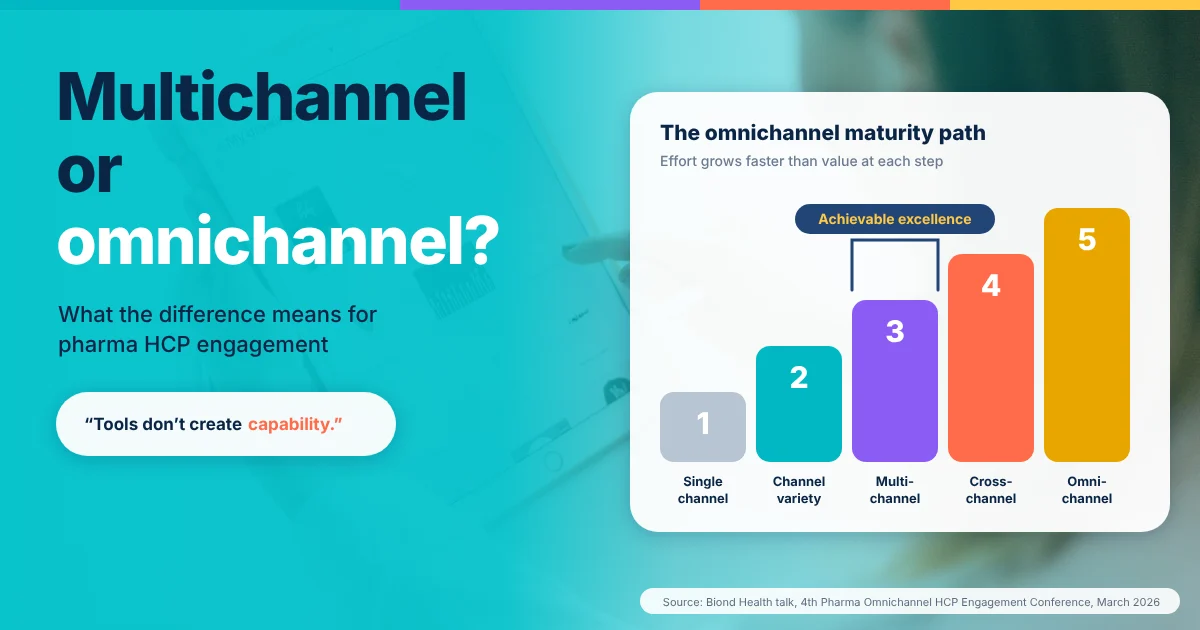
Yacin Marzouki of Biond Health, speaking at the 4th Pharma Omnichannel HCP Engagement Conference in Barcelona in March 2026, described five levels of maturity:
Because most content never reaches the doctor. Marzouki described medical affairs as producing the raw materials, brand teams turning them into content, and omnichannel delivering it so HCPs can "make the most informed prescribing decision". Veeva's 2025 Pulse data shows the gap: field teams share materials in fewer than half of interactions, and nearly 80% of approved content is rarely or never used. When content is used, treatment starts double.
Digital is now the bigger share of engagement, but not yet the better experience. DT Consulting's 2025 survey of 6,020 HCPs in 13 countries found that digital channels account for 51% of customer engagement, yet digital interactions scored 52 on its customer experience index, against 57 for non-digital ones. The share of HCPs it classes as digital enthusiasts rose five points to 22%. More channels alone do not make a better experience; connecting them does.
Morgwn Shaw of Bristol Myers Squibb gave a candid case study of a decade-long journey. His opening line set the tone:
"We've been sold labels; the customer just wants an answer."
Morgwn Shaw, Bristol Myers Squibb, 4th Pharma Omnichannel HCP Engagement Conference, March 2026
He traced four phases: foundations (2016–2018: iPad detailing and web hubs), the engine (2019–2021: marketing automation and automated journeys), the brain (2022–2024: next best action and data lakes) and the great augmentation (2025 onwards: generative AI and predictive personalisation). Each phase, he argued, bought new technology without building the matching capability, leaving the industry to enter the AI era with "10 years of unaddressed debt".
Shaw named three traps, one for each earlier phase:
His summary of the industry's habit: "Chasing tools instead of building muscles." Marzouki made the same point with a luxury car that sat almost unused after purchase: "Tools don't create capability." Both argued that maturity needs the right mindset and skills before the toolset.
No, according to Marzouki. Effort rises much faster than value as you climb the maturity levels, and global headquarters usually have stronger data, bigger teams and central capabilities than local markets, which work with limited teams, fragmented data and variable budgets. His conclusion: "Not every market can reach omnichannel maturity, so the real goal is achievable excellence."
That means consistent multichannel excellence: a clear strategy with defined segments and priorities, relevant content sequenced in campaigns, coordinated channels and simple measurement. As he put it in his presentation, "Consistently above average beats chasing perfection."
Header photo: Marek Levák on Unsplash.
Omnichannel in pharma is an approach where all channels used to engage healthcare professionals, such as reps, email, webinars, websites and medical science liaisons, share data and are orchestrated around each HCP's needs and behaviour, so every interaction builds on the previous one.
Multichannel uses several channels, often planned separately by different teams. Omnichannel connects those channels with shared data and journey logic, so the HCP experiences one continuous conversation.
It is the step between multichannel and omnichannel, where customer journeys are mapped and trigger-based logic links channels, but orchestration is not yet real-time across all touchpoints.
Not always. Speakers at our conference argued that many markets get better results from consistent multichannel excellence, with clean data, relevant content and coordinated teams, than from partly built omnichannel programmes.
The Pharma Omnichannel HCP Engagement Conference, organised by UBIQ Events, brings together pharma commercial, medical and digital leaders to discuss omnichannel strategy, HCP experience, AI and engagement measurement.


