Key takeaway
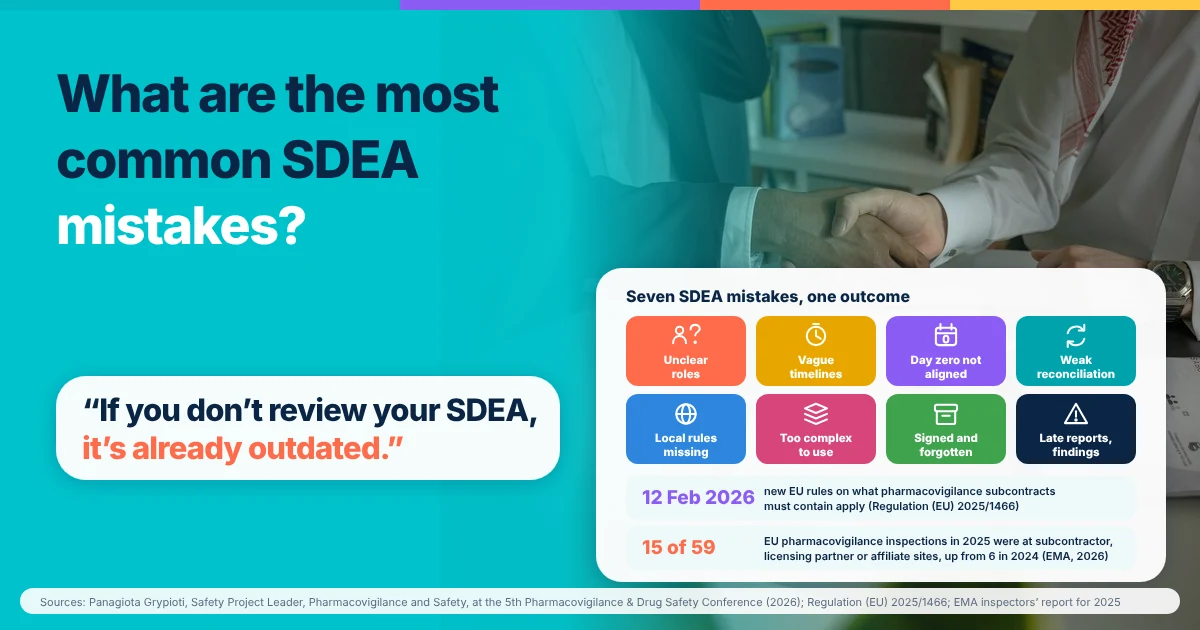
Seven mistakes make safety data exchange agreements fail in practice, from unclear roles to partners who do not share a definition of day zero. Since 12 February 2026, EU rules also prescribe what subcontracts for pharmacovigilance must contain. What we heard on our stage, and how to fix it.
Short answer: Seven mistakes come up again and again: unclear roles, vague or unrealistic timelines, partners who define day zero differently, weak case exchange and reconciliation, local requirements left out, documents too complex to use, and agreements that are signed and then forgotten. None of them is a drafting problem. They happen when a safety data exchange agreement (SDEA) is treated as a legal formality instead of a description of how two companies will actually move safety data. The stakes rose on 12 February 2026, when revised EU rules began to prescribe what subcontracts for pharmacovigilance activities must contain.
A safety data exchange agreement is a formal contract between two or more parties involved in developing, licensing, distributing or marketing a medicine. It sets out who collects safety information, who receives it, in what format and by when, so that the MAH can report to regulators on time. A pharmacovigilance agreement (PVA) is broader: it allocates all pharmacovigilance responsibilities between partners, including signal management, risk management, literature screening and periodic reports, with safety data exchange as one part. In daily use the two terms are often interchangeable.
The number of such agreements keeps growing, because medicines increasingly change hands. A McKinsey analysis found that since 2018 more than 70% of revenues from new molecular entities have come from externally sourced products (McKinsey, January 2025). J.P. Morgan put announced biopharma licensing value at $221.1 billion for the first nine months of 2026, after a record $274.3 billion in 2025 (J.P. Morgan, October 2026). Outsourcing adds to it: one market research estimate values pharmacovigilance outsourcing at $9.15 billion in 2026, up from $7.92 billion in 2025 (Mordor Intelligence, January 2026). Every licensing deal, distributor, co-promotion partner and service provider needs safety data to flow correctly. A 2022 position paper from Medicines for Europe noted that large off-patent companies can have hundreds or even thousands of licensing relationships.
Because the law puts the whole system on the MAH. Under Implementing Regulation (EU) 520/2012 (2012), an MAH may subcontract pharmacovigilance activities but keeps full responsibility, and must list its subcontracts in the pharmacovigilance system master file. GVP Module I (2012) asks for subcontracts that are detailed and up to date. GVP Module VI (2017) asks for explicit procedures and detailed agreements with any contractual partner, so that reports arrive on time and are not duplicated.
The 2025 revision made this concrete. Implementing Regulation (EU) 2025/1466, applicable from 12 February 2026, adds four mandatory elements to subcontracts: a clear description of the third party's roles and responsibilities, the safety data exchange obligations and method, the arrangements for inspections and audits, and the third party's agreement to be audited by or for the MAH. Third parties may not subcontract pharmacovigilance tasks further without the MAH's written consent, and MAHs must audit their subcontractors on a risk basis. The revised GVP Module III, effective 10 September 2026, confirms that subcontracted third parties can be inspected.
Who counts as a third party is still being settled. At its industry stakeholder meeting on 20 October 2026, the EMA described a third party as any organisation to which a pharmacovigilance task is subcontracted, said oversight should be risk-based, and announced that a formal definition will be developed for the next revision of GVP Annex I (EMA, October 2026). The EMA's own question-and-answer document on the regulation covers signal detection only, not subcontracting. Lawyers have pointed to the gap: a law firm briefing noted uncertainty over which third parties qualify as subcontractors and warned that existing agreements may need to be renegotiated (Sidley Austin, October 2025). Until the definition arrives, the safe reading is the broad one.
The clock is where agreements are tested. GVP Module VI sets day zero as the date the minimum case information reaches any personnel of the MAH, including medical representatives and contractors. If a distributor holds a serious case for a week before passing it on, the MAH has already used half of its 15 days (EMA, December 2025). In the EMA inspectors' report for 2025, management and reporting of adverse reactions was the area with the most findings in CHMP-requested inspections: 22 of 88, with 35 of the 88 graded major and none critical. Five of those seven inspections took place at a subcontractor, licensing partner or affiliate site.
The same logic applies outside Europe. After an inspection in early 2025, FDA investigators recorded that a manufacturer had expanded a vendor's responsibilities to include adverse event surveillance through its call centre, and that more than 480 reports of serious and unexpected events from a five-month period were then submitted late (FDA Form 483, February 2025). The warning letter that followed in March 2026 stated that compliance remains the company's responsibility when it contracts with a vendor. Switzerland has moved in the same direction: Swissmedic guidance valid from 1 September 2026 asks for delegated responsibilities to be set out in writing and for a structured, verifiable oversight process with KPIs, documented audits and escalation channels.
At the 5th Pharmacovigilance & Drug Safety Conference in April 2026, Panagiota Grypioti, Safety Project Leader, Pharmacovigilance and Safety at Excelya, a contract research organisation, gave a sponsored keynote on the SDEA mistakes companies make most often. Her diagnosis was about organisations, not paperwork. Mistakes happen, she said, when legal and pharmacovigilance teams are misaligned, when regulatory expectations are poorly understood, when templates are over-relied on, when operations has no input during drafting, and when nobody really understands the partner's business model.
"SDEA issues are not document issues — they are organizational issues."
Panagiota Grypioti, Safety Project Leader, Pharmacovigilance and Safety, Excelya, 5th Pharmacovigilance & Drug Safety Conference, April 2026
She listed four phrases that should worry any safety lead: "We used a global template", "This is how we always do it", "It's written somewhere else (SOP)" and "We will clarify later".
She added a list of less visible gaps: no process for product quality complaints or medical information enquiries, no audit and inspection clauses, no business continuity plan, no escalation path, and activities that start before the agreement is signed. Her real-life scenario shows how it unfolds: roles unclear, a case received but not processed, reporting delayed, a late submission and an inspection finding. "Small gap → big impact".
Grypioti's best practices start with the collaboration itself: tailor the agreement to the specific model, define roles clearly, map every source of safety data across the partnership, align timelines with regulatory requirements, keep SOPs and the SDEA consistent, schedule regular reviews, keep QPPV contact details current and train all parties on their obligations. One practical tip was to keep territories, products and contacts in a separate appendix so they can be updated without renegotiating the contract.
A consistent SDEA, in her presentation, states the MAH, territories and products in scope; names the owner of the global safety database and the data flow; sets the governance, communication and escalation pathways; defines measurable KPIs, reconciliation and compliance monitoring; and covers lifecycle management, including updates, reviews and business continuity. "A good SDEA does not just define responsibilities — it defines how the partnership operates in reality."
On timelines, industry practice gives a benchmark. A TransCelerate survey of 378 pharmacovigilance agreements at 18 companies, published in 2023, found that fatal or life-threatening related serious adverse events from clinical trials were most often exchanged within four to five days, and other related serious events within eight to ten days (Therapeutic Innovation & Regulatory Science, 2023). Whatever numbers you choose, write them as calendar days from a day zero both partners have defined in the same way.
For the wider role of the person who signs off on all this, see our post on what a QPPV does.
These topics will be on the agenda at the 6th Pharmacovigilance & Drug Safety Conference in Barcelona on 27–28 April 2027, organised by UBIQ Events.
A legally binding contract between companies involved in developing, licensing, distributing or marketing a medicine. It defines how adverse events and other safety information are shared so the marketing authorisation holder can meet its reporting obligations.
An SDEA focuses on the exchange of safety data. A pharmacovigilance agreement covers all pharmacovigilance responsibilities between partners, including safety data exchange. The terms are often used interchangeably.
Whenever another party may receive or handle safety information for a product: licensing and co-marketing partners, distributors, CROs, call centres and other service providers. EU guidance asks for explicit procedures and detailed agreements with any such partner.
Since 12 February 2026: a clear description of the third party's roles and responsibilities, the safety data exchange obligations and method, inspection and audit arrangements, and the third party's agreement to be audited. Further subcontracting needs the MAH's written consent.
The date on which the minimum information for a valid case is first received by anyone working for the MAH, including contractors. Reporting deadlines of 15 days for serious cases and 90 days for non-serious EEA cases count from that date.
On a fixed schedule and whenever products, territories, partners, contacts or regulations change. An agreement that is signed and never reviewed drifts out of date as contacts, products and rules move on.
The Pharmacovigilance & Drug Safety Conference, organised by UBIQ Events, brings together QPPVs and drug safety leaders from across Europe. The 6th edition takes place in Barcelona on 27–28 April 2027.


