Key takeaway
The QPPV is the person legally responsible for a company's pharmacovigilance system in the EU. What the role involves in 2026, how AI changes it, and what J&J's Jan Cleerbout sees for the QPPV of 2030.
Short answer: A QPPV (Qualified Person Responsible for Pharmacovigilance) is the named individual legally responsible for a marketing authorisation holder's pharmacovigilance system. In the EU, the QPPV must reside and operate in the EU or EEA, oversee the safety profile of every product, have authority over risk management plans and act as the 24-hour contact point for regulators and inspectors. In 2026 the role is widening: as AI enters case processing, signal detection and report writing, the QPPV must keep oversight of tools they did not build and explain them during inspections.
The QPPV is a natural person, not a department, who is accountable for how a company's pharmacovigilance system works. EU law requires every marketing authorisation holder (MAH) to operate a pharmacovigilance system and to have an appropriately qualified person responsible for it. The requirement was introduced by Directive 2004/27/EC and detailed in Good Pharmacovigilance Practices (GVP) from 2012.
The QPPV's responsibility covers the whole system and its quality: standard operating procedures, contracts with vendors, safety database operations, the timeliness of expedited case reports and periodic safety update reports, audits and staff training. GVP also requires the QPPV to have "sufficient authority" to influence how that system performs.
GVP Module I groups them around oversight, quality and contact with regulators. The QPPV should:
The QPPV must also have access to the pharmacovigilance system master file (PSMF) and be able to verify that it is accurate.
Rather than naming a specific degree, GVP sets a standard of knowledge. The marketing authorisation holder must ensure the QPPV "has acquired adequate theoretical and practical knowledge" of pharmacovigilance, and the QPPV should have skills for managing pharmacovigilance systems, plus expertise or access to expertise. If the QPPV has not completed basic medical training, the company must ensure the QPPV "is assisted by a medically trained person", and that assistance must be documented.
Three further rules shape the job. Each pharmacovigilance system can have only one QPPV. The QPPV's name and contact details must be submitted to EU authorities and recorded in the PSMF. And the QPPV should be able to trigger an audit where appropriate.
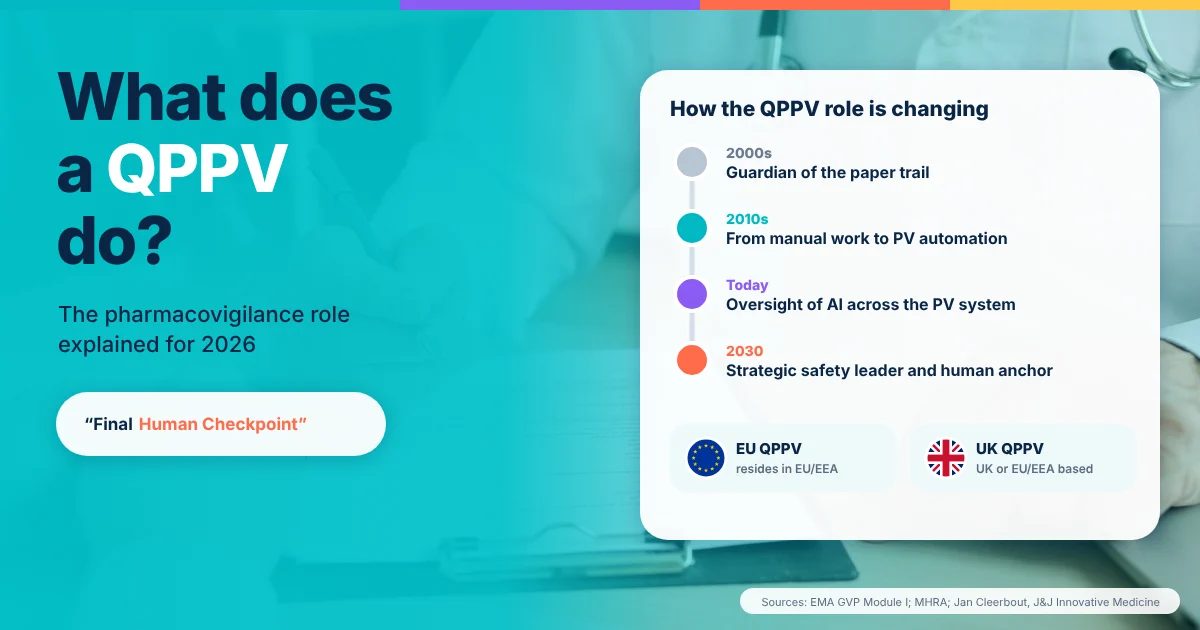
In the EU, the QPPV must reside and operate in the EU, or in Norway, Iceland or Liechtenstein under the EEA agreements. Since Brexit, products authorised in the UK need a UK QPPV, who may reside and operate in the UK or the EU/EEA. If that person is outside the UK, the MAH must nominate a national contact person for pharmacovigilance in the UK, and the PSMF must be electronically accessible from a UK address. MHRA states there is no temporary exemption. Many global companies also run a network of local or regional QPPVs for markets outside Europe.
At the 5th Pharmacovigilance & Drug Safety Conference in Madrid in April 2026, Jan Cleerbout, Deputy QPPV at J&J Innovative Medicine and a physician with 23 years in the industry, traced the role from its origins to 2030. He described the early 2000s as "Data-rich but insight-poor", with millions of paper case reports in siloed databases and a check-box approach to compliance. Today's QPPV in a large company works across many stakeholders, legacy systems, vendors, mergers and growing data volumes. His summary of the journey:
"From Regulatory Librarian to Strategic Safety Leader"
Jan Cleerbout, J&J Innovative Medicine, 5th Pharmacovigilance & Drug Safety Conference, April 2026
AI now reaches almost every part of the pharmacovigilance system. The use cases Cleerbout showed covered case intake and processing, literature screening, report authoring, causality assessment, signal detection and prioritisation, benefit–risk monitoring, regulatory intelligence and PSMF management. Examples included generative AI that extracts patient, product and event details from unstructured documents into the safety database, a large language model that flags dechallenge and rechallenge cases for medical review, and a collaborative authoring tool for periodic reports with human-in-the-loop review.
Volume is a big part of the reason. EudraVigilance collected 1,765,581 individual case safety reports in 2025, and EMA's signal team reviewed 1,201 potential signals. The rules are changing too: Implementing Regulation (EU) 2025/1466 removed the requirement for companies to submit validated signals to EMA and national authorities as standalone notifications, and EMA says GVP Module IX on signal management will be updated in 2026 to match.
All this creates what Cleerbout called the QPPV challenge. The QPPV must keep oversight and authority over the whole system and is increasingly asked to endorse AI projects, yet "QPPVs are not AI Experts". His advice: "Ask questions and ask early!"
Inspectors are already asking those questions. Cleerbout summarised the considerations raised for MAHs at a QPPV forum in November 2025:
The guidance behind those questions is still taking shape. The CIOMS Working Group XIV report on AI in pharmacovigilance was published on 4 December 2025, and the EMA and FDA issued joint principles of good AI practice in January 2026. We covered both in Can AI Detect Drug Safety Signals Faster?.
Cleerbout described three shifts:
He also sees the QPPV becoming a global strategic safety officer: governing vendors and AI, bridging functions and translating data science into medical safety strategy. His guiding principle was "Speed of Innovation but still with Patient Safety First".
Header photo: Vitaly Gariev on Unsplash.
QPPV stands for Qualified Person Responsible for Pharmacovigilance. It is the individual a marketing authorisation holder names as responsible for its pharmacovigilance system.
A QPPV oversees a company's pharmacovigilance system and its quality, keeps an overview of product safety profiles and emerging concerns, has authority over risk management plans, ensures safety data and reports reach regulators correctly and on time, and acts as the 24-hour contact point for authorities and inspections.
Yes. The EU QPPV must reside and operate in the EU, or in Norway, Iceland or Liechtenstein.
A deputy QPPV supports the QPPV and covers the role when the QPPV is absent. EU guidance requires back-up procedures for the QPPV's absence.
No. EU guidance requires the QPPV to have adequate theoretical and practical knowledge of pharmacovigilance. If the QPPV has not completed basic medical training, the company must ensure the QPPV is assisted by a medically trained person and document that assistance.
Each pharmacovigilance system can have only one QPPV. Companies with several pharmacovigilance systems, or products in both the EU and UK, may have more than one QPPV in total.
UK-authorised products need a UK QPPV, who can be based in the UK or the EU/EEA. If the UK QPPV is outside the UK, a national contact person for pharmacovigilance must reside and operate in the UK.
The Pharmacovigilance & Drug Safety Conference, organised by UBIQ Events, brings together QPPVs and drug safety leaders to discuss AI, inspection readiness, signal management and the future of patient safety.


