Key takeaway
AI changes who makes decisions in healthcare and how pharma work gets done. Five principles for reorganising around AI, the evidence that workflow redesign beats tool rollout, and a diagnostic to test your own company.
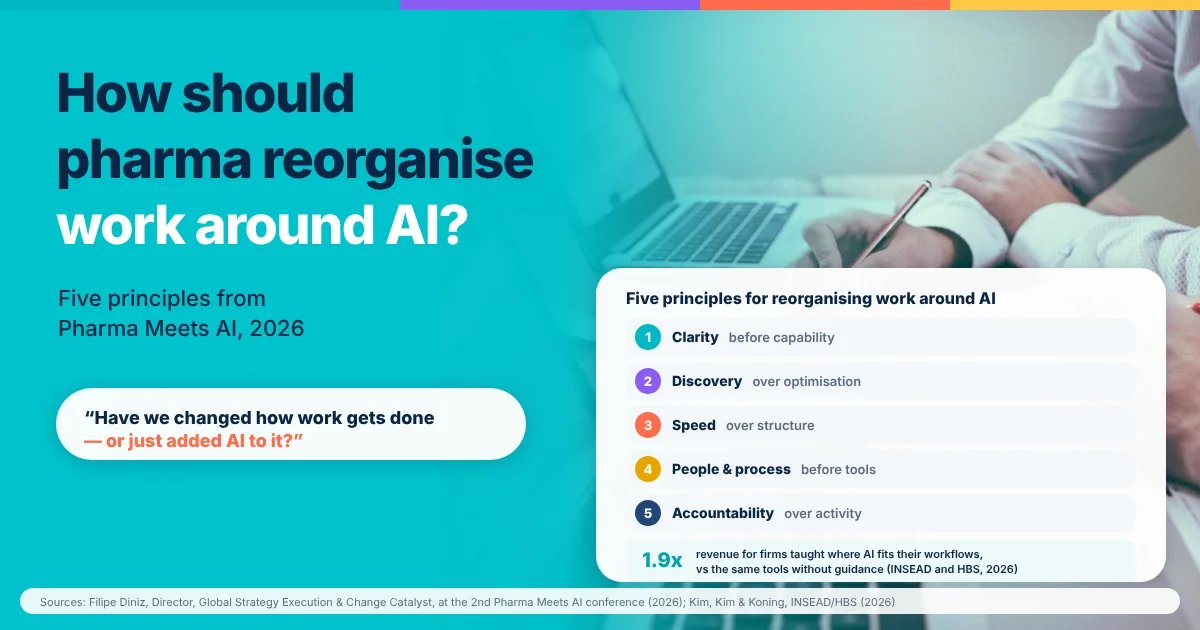
Short answer: Not by handing out tools. The evidence from 2025 and 2026 points the same way: companies that get value from AI redesign how work is done, decide where AI creates value before building capability, and invest more in people and process than in models. On our stage, Filipe Diniz set out five principles for doing that inside a large pharma company: clarity before capability, discovery over optimisation, speed over structure, people and process before tools, and accountability over activity.
Diniz framed the pressure on pharma as four constraints arriving at once: more complex portfolios to launch, policy and geopolitics shaping competition as much as products, decisions that are increasingly made by algorithms, and AI-native competitors that work differently. On the last point, his presentation was direct: "This is not acceleration—it is a fundamentally different operating model", and "The competitive gap is no longer incremental—it is structural, and it is widening fast".
The third constraint matters most for commercial and medical teams. In his words: "The prescribing decision is becoming increasingly machine-mediated, shifting influence from physicians alone to the algorithms that guide them." The data agrees. KFF found that 32% of US adults had used an AI chatbot for health information in the past year, equal to the share using social media for health, and 42% of those asking about physical health did not follow up with a professional. The AMA's 2026 survey of 1,692 physicians found 72% using at least one AI use case, with research and standards-of-care summaries the most common. On the payer side, 92% of US health insurers surveyed by state regulators in 2025 use, plan or explore AI, and 29% of models in prior authorisation were already in production (NAIC, May 2025).
If algorithms increasingly sit between a company and its customers, the way the company works has to change too. We looked at the HCP side of this in KOL vs DOL: What Is a Digital Opinion Leader in Pharma?.
The clearest evidence comes from a 2026 field experiment by Hyunjin Kim and Dahyeon Kim of INSEAD and Rembrand Koning of Harvard Business School. All 515 start-ups in the study received the same AI tools, credits and technical training. Half also received case studies on how AI-native firms reorganise their workflows and teams. That half discovered 44% more AI use cases, mostly in product development and strategy, completed 12% more tasks, were 18% more likely to acquire paying customers and generated 1.9 times the revenue, while their demand for outside capital fell by nearly 40%. Diniz's reading of the study: "The bottleneck isn't the model; it's the ability to discover the right application."
Large-company surveys say the same. McKinsey's 2026 State of AI survey of 1,719 organisations found that nearly three-quarters of high performers had fundamentally redesigned workflows, up from 55% a year earlier, compared with about a quarter of everyone else. BCG's 2025 survey of 10,600 workers found 72% using generative AI regularly but only 36% feeling adequately trained, and just 25% of frontline employees saying leaders give enough guidance. Microsoft's 2026 Work Trend Index, based on 20,000 knowledge workers, found that organisational factors such as culture and manager support explained about two-thirds of the variation in AI impact, and that only 13% of AI users felt rewarded for reinventing their work with AI (vendor research).
That is why Diniz leaned on BCG's rule of thumb that AI investment should split roughly 10% algorithms, 20% technology and 70% people and process (BCG, 2024). In his words: "Access to AI tools alone will result in lower performance than structured guidance on how to apply AI within workflows".
At the 2nd Pharma Meets AI conference in Barcelona on 20 April 2026, Filipe Diniz, Director, Global Strategy Execution & Change Catalyst at MSD, spoke in a personal capacity about rewriting how work gets done. He was explicit that his views were his own and not a statement of his employer's strategy. His central question:
"How do we rewrite how work gets done within the constraints of a large organization?"
Filipe Diniz, Director, Global Strategy Execution & Change Catalyst, MSD, 2nd Pharma Meets AI, April 2026
His answer was five principles, each with a question leaders can ask themselves.
His presentation turned the five into a diagnostic: fifteen questions, each scored from broken to scaled. It is a useful exercise for any leadership team before the next budget round.
Diniz's most practical slide split work into three columns. Core human work ("I do"): strategic direction, trade-off decisions under uncertainty, stakeholder alignment, ethical judgment and accountability. Augmented work ("we do"): scenario exploration, analysis and synthesis, content development, planning and coordination. Automated work ("AI does"): routine, repeatable processes, data processing and reporting, standardised communication, administrative tracking.
The split matches how AI is being used in practice. Anthropic's Economic Index found that by September 2025 automation-style usage of its assistant had edged past augmentation for the first time, at roughly half of conversations, and that 77% of business API usage followed automation patterns (vendor data). The question for pharma leaders is not whether tasks will be automated, but whether the human and shared columns are designed on purpose.
For the measurement side, see How Do You Evaluate Generative AI in Pharma? 2026 Guide. For why pilots stall, see Why Do Most Pharma AI Projects Never Leave the Pilot Stage?.
These topics will be on the agenda at the 3rd Pharma Meets AI conference in Barcelona on 19–20 April 2027.
Because value comes from redesigned workflows, not from tool access. Field evidence in 2026 showed firms given the same AI tools performed very differently depending on whether they were taught to reorganise work around them, and McKinsey's survey finds workflow redesign is the strongest marker of AI high performers.
A BCG rule of thumb from 2024: roughly 10% of effort goes to algorithms, 20% to technology and data, and 70% to people, process and change. Speakers at Pharma Meets AI used it to argue for more investment in adoption than in building.
It means that clinical, patient and payer decisions are increasingly shaped by algorithms: AI summaries that physicians read, chatbots that patients consult, and models that insurers use in prior authorisation. Influence shifts from individual experts to the systems that inform them.
Strategic direction, trade-off decisions under uncertainty, stakeholder alignment, ethical judgment and final accountability. Analysis, synthesis and content development can be shared with AI, while routine data processing, reporting and administrative tracking can be automated.
Ask the five questions: Is the value thesis clear? Is AI applied where it matters or where it is easiest? Can teams experiment fast? Has work changed or just been augmented? Is impact measured and owned?
Pharma Meets AI, organised by UBIQ Events, brings together pharma leaders to discuss AI governance, agentic AI, data foundations and new ways of working. The 3rd edition takes place in Barcelona on 19–20 April 2027.


