Key takeaway
Home blood self-testing can turn monthly lab visits into weekly data points. The first FDA-cleared home creatinine system (2026), what weekly eGFR readings do to CKD trial endpoints and costs, new ICH and EU rules, and six ways to de-risk the devices.
Short answer: Yes, where the endpoint depends on frequent, objective measurements. In chronic kidney disease (CKD) trials, the primary endpoint is often the slope of kidney function (eGFR) over time, and a slope measured weekly at home is more precise than one measured monthly at a clinic. More precision means fewer patients, shorter trials and lower costs. The catch is that the device, the app and the data pipeline must be validated to clinical-trial standards, and sites take on a new role as remote coordinators. On our stage, Tyler O'Neill set out how one sponsor is testing exactly that in CKD, and why he sees it as a blueprint for other therapy areas.
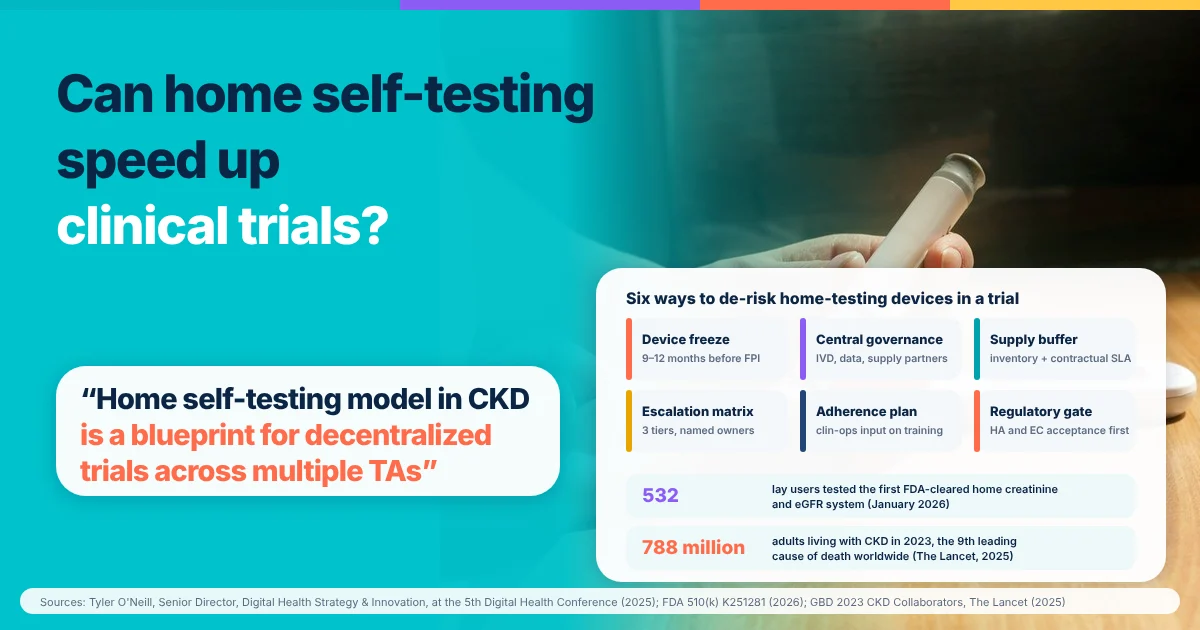
CKD is common, slow and expensive to study. The 2025 Global Burden of Disease analysis put the number of adults living with CKD at 788 million, 14.2% of the adult population on an age-standardised basis, with 1.48 million deaths in 2023. Earlier modelling projected CKD to be the fifth leading cause of death by 2040 (The Lancet, 2018).
Because kidney function usually declines slowly, trials that wait for hard outcomes such as kidney failure need thousands of patients and years of follow-up. Regulators therefore accept surrogate endpoints based on eGFR, the estimated glomerular filtration rate calculated from serum creatinine. In his presentation, O'Neill listed the accepted options: a doubling of serum creatinine (a 57% GFR decline), 40% and 30% GFR declines, and the GFR slope itself. The strongest evidence for slope comes from Inker and colleagues, whose 2023 individual-participant meta-analysis concluded that total eGFR slope can serve as a primary endpoint in trials of CKD progression. Sponsors are now using it that way. Bayer's FIND-CKD trial in more than 1,500 patients with non-diabetic CKD, presented in June 2026, used total eGFR slope as its primary endpoint and reported a decline of 3.3 versus 4.0 mL/min/1.73 m² per year, a difference of 0.7. ProKidney has said the FDA confirmed in 2025 that eGFR slope from its PROACT 1 study can serve as the surrogate endpoint for an accelerated approval, with a 1.5 mL/min/1.73 m² effect set as the bar.
A slope is only as good as the points that define it. O'Neill's core argument was statistical: monthly clinic measurements over 24 months give 24 noisy points; weekly home measurements give more than 100. In his words, "High frequency self-testing reduces residual variance and minimizes confounding physiological noise, with equivalent statistical power to reduce sample size (n), compress trial duration, & reduce study costs".
At the 5th Digital Health Conference in Madrid on 24 October 2025, Dr Tyler O'Neill, Senior Director, Digital Health Strategy & Innovation at Evinova, the health-tech business AstraZeneca launched in 2023, presented a case for digitally integrated creatinine self-testing in CKD drug development.
His worked example was a two-arm, placebo-controlled Phase 2b study in CKD patients with a primary endpoint of change in eGFR slope from baseline. Replacing some site visits, local lab sampling and home nursing visits with patient self-testing twice a week, and assuming 50% compliance alongside monthly central lab measurements, his model estimated a cost reduction of around $10 million for the study. He was careful to label the assumptions, including a device coefficient of variation of 17% and a per-patient Phase 2 cost of $140,000 to $150,000, and to exclude the cost of delivering self-testing itself.
The pilot his team ran was built around a decision gate rather than a conviction:
"Proceed with patient self-testing only if it demonstrates a quantifiable benefit over site-only testing and is necessary to achieve the Ph2b global study objectives."
Dr Tyler O'Neill, Senior Director, Digital Health Strategy & Innovation, Evinova, 5th Digital Health Conference, October 2025
The pilot measured three things: clinical and statistical endpoints, patient and site factors, and operational feasibility.
The hard part is not the chemistry. Point-of-care creatinine measurement uses electrochemical or optical biosensors that are small, cheap and fast, with known weaknesses such as electrode fouling and optical interference. The hard part is turning a reading in someone's kitchen into source data an auditor will accept.
O'Neill's example data flow had six links: a third-party in vitro diagnostic analyser that is auto-calibrated and lot-tracked and calculates eGFR with safety thresholds; a smartphone app that validates the test time and procedure, captures context and adds a digital signature with time and location; encrypted transfer by Bluetooth or NFC and HTTPS; a data validation service that checks for outliers, repeat tests, device health and safety thresholds; an API gateway; and a GxP audit trail with immutable storage of raw values and metadata. His summary: end-to-end integration "provides tamper evident, cryptographically signed data stream, establishing self-testing as auditable trial master record source data".
The science and the regulation are catching up. A Dutch validation study published online in November 2025 compared finger-prick dried blood spot creatinine with venous plasma in 122 outpatients: R² of 0.967 for creatinine, 0.858 for eGFR, and 91% sensitivity and 96% specificity for detecting eGFR below 60. A follow-up feasibility study in kidney transplant patients, published in January 2026, found that creatinine from at-home finger-prick samples held for 24 hours at room temperature stayed within CLIA acceptance limits, although only 16 of 38 patients returned a home sample. On 21 January 2026 the FDA cleared the Nova Max Creat eGFR Monitoring System for single-patient home use by prescription: fingertip capillary blood, a result in about 30 seconds, eGFR calculated with the CKD-EPI 2021 equation, and a lay-user study of 532 adults against laboratory venous plasma. The system has no connectivity, which is exactly the gap O'Neill's data flow is designed to fill. A second point-of-care creatinine system intended for untrained home users has a 200-patient clinical performance study registered (NCT07251075), and at least one Phase 1 CKD programme registered in 2025 includes a cohort to test home serum creatinine self-measurement with a smartphone. The cleared smartphone kidney test already on the market measures urine albumin-to-creatinine ratio, a different marker.
O'Neill was direct that the burden moves rather than disappears. In his presentation: "Clinical sites become centralized co-ordinators focusing on remote compliance monitoring and staff optimization". Phlebotomy and lab logistics give way to remote compliance monitoring, supply management and technical support. The gain is that the new work is automated and scalable, and that "Decentralized model enables effective trial scaling in high-burden or geographically restricted populations".
For patients, the case rests on convenience, a sense of control and access to their own trend data, which he linked to recruitment and retention: "Positive patient experience → higher recruitment & improved long-term retention". The wider evidence is mixed. A peer-reviewed analysis in BMJ Open (March 2026) of 444 industry-sponsored metabolic-disease trials with US sites found that 27.9% used decentralised elements, rising from 11.4% in Phase 1 to 41.6% in Phase 3, but that decentralisation was not associated with significantly shorter trials: 17.3 versus 18.3 months in Phase 2 and 23.4 versus 25.0 in Phase 3. A 2025 study in Frontiers in Medicine, authored by a decentralised-site vendor, found that community-integrated sites in a Phase 3 neurodegeneration trial screened 20.6 participants per site per month against 11.8 for traditional sites, with no difference in discontinuation. Tufts CSDD modelling from 2022 estimated that decentralised elements raise expected net present value by $8.75 million in Phase 2 and $41.2 million in Phase 3, assuming a three-month cycle-time reduction. The lesson is that decentralisation alone does not shorten a trial; it has to change the endpoint or the sample size, which is the argument for self-testing in CKD. An often-quoted estimate that 70% of potential participants live more than two hours from a study site has no clear primary source, so we do not rely on it.
Regulators have made room for this. The FDA's final guidance on trials with decentralised elements (September 2024) treats telehealth, home visits and local testing as individual elements that a sponsor can justify, and keeps investigator responsibility for data integrity. In March 2026 the FDA went a step further and asked the industry, through a formal request for information, where it needs guidance on digital health technologies in drug trials, naming digitally derived endpoints as a workshop topic. In Europe, the Commission, HMA and EMA updated their 2022 recommendation paper on decentralised elements in October 2025 to cover cross-border trials, and ICH E6(R3) Annex 2, the first good clinical practice text written for decentralised and pragmatic trials and real-world data sources, reached Step 4 in June 2026 and applies in the EU from 15 January 2027.
The most reusable slide in his presentation was a six-point mitigation blueprint from lessons learned:
His closing point was that CKD is a template: "Home self-testing model in CKD is a blueprint for decentralized trials across multiple TAs", wherever frequent, objective biomarkers matter, such as neutrophil counts or liver function tests in oncology and C-reactive protein in immunology. The core validation it offers is that it "Proves complex laboratory-grade data is safe, reliable, and compliant outside of the clinical setting".
For the wider question of which digital tools pharma should build with partners, see What Makes Pharma–Digital Health Partnerships Work?. For the device side of connected data, see What Does the FDA Expect on Medical Device Cybersecurity?.
These topics are on the agenda at the Digital Health Conference, organised by UBIQ Events, whose 6th edition took place in Barcelona on 3–4 November 2026.
eGFR slope is the rate at which estimated kidney function changes over time. Because kidney failure takes years to develop, trials use the slope as a surrogate endpoint. A 2023 meta-analysis of 66 trials found that treatment effects on three-year slope predicted effects on clinical kidney outcomes, and in 2026 Bayer's FIND-CKD trial reported on total eGFR slope as its primary endpoint.
Yes. In January 2026 the FDA cleared the first creatinine and eGFR monitoring system for prescription home use, based on a fingertip blood sample and a lay-user study of 532 adults. Dried blood spot methods have also been validated against laboratory plasma creatinine. For clinical trials, the open question is connectivity and data integrity: the cleared device does not transmit results, so sponsors still need an app, validation service and audit trail.
A trial in which some or all activities happen away from the traditional site, such as telehealth visits, home nursing, local labs, direct-to-patient drug shipment or patient self-testing. The FDA's September 2024 guidance, the EU's recommendation paper (updated October 2025) and ICH E6(R3) Annex 2 (in force in the EU from January 2027) describe how sponsors can use these elements.
It changes it. Sites do less phlebotomy and lab handling and more remote compliance monitoring, supply management and technical support. Speakers at our conference described this as a shift from clinical to coordination work that is easier to automate and scale.
More frequent measurements reduce the variance of the eGFR slope, which lets a trial reach the same statistical power with fewer patients or a shorter follow-up. A modelled Phase 2b example presented at our conference estimated savings of about $10 million, before the cost of running the self-testing programme. Decentralisation on its own has not shortened trials in published analyses; the gain comes from changing the endpoint or sample size.
The Digital Health Conference, organised by UBIQ Events, brings together pharma, MedTech and digital health leaders to discuss digital endpoints, connected devices, AI and regulation.


