Key takeaway
Not every AI project in pharma R&D carries the same risk. A five-dimension map from our stage shows how to tell them apart: value chain stage, maturity, type of AI, data and regulatory impact. Plus what changes with generative and agentic systems, and what regulators now expect.
Short answer: You assess it by asking five questions about each project and reading the answers together: where in the R&D value chain the model is used, how mature and widely deployed it is, what type of AI it is, what data it runs on, and how much regulatory and ethical weight its output carries. A literature summariser used in early discovery and a model built into a diagnostic are both called AI, but an error in the first costs a scientist some time, while an error in the second can reach a patient. The risk map we heard on our stage makes that difference visible, so that governance can be light where the stakes are low and strict where they are high. That is also what the EMA and FDA asked for in their joint 2026 principles: a risk-based approach and a clear context of use.
At the 2nd Pharma Meets AI Conference in Barcelona in April 2026, Alex Turpin, Head AI Governance R&D at AstraZeneca, opened the first day with a keynote on governance as an enabler of innovation. We have already written about one half of his argument, the case for building governance in from the start and his image of governance as a ladder from proof of concept to production, in Why Do Most Pharma AI Projects Never Leave the Pilot Stage?. This post is about the other half, which answers a more practical question: when a company has hundreds of AI projects in R&D, how does it tell which ones need heavy controls and which ones do not?
He started from a claim that may surprise anyone who thinks of AI governance as a new burden imposed on science. In his view, the industry has been doing it for decades under other names.
"AI governance is not a new concept for pharma. It's model governance, data integrity, and reproducibility applied to a new class of models."
Alex Turpin, Head AI Governance R&D, AstraZeneca, 2nd Pharma Meets AI Conference, April 2026
The examples he gave are familiar to anyone who has worked in a regulated laboratory or on a clinical trial. Computerised systems have had to be validated since the 1980s. Statistical models used in trials have to be specified in advance, validated and monitored for drift. Research data is expected to be findable, accessible, interoperable and reusable, and every transformation applied to it has to be logged and explainable. Scientists track their hypotheses, register their analysis plans, document where their data came from, build pipelines that others can reproduce, and submit their work to peer review and ethical oversight. When a technology company today sets up a model registry, an experiment tracker, a red team or an AI ethics board, it is rebuilding the same habits under new names. As one of his slides put it, the enterprise is catching up with what research always knew.
If the discipline is so well established, why does AI still feel difficult to govern? His answer was that the word now covers very different things, used in very different places, and that a single process cannot fit them all. He called this variety the R&D AI risk zoo, and the rest of his presentation was an attempt to put it in order.
The first reason is that AI in R&D does a different job from AI in the rest of the company. Turpin drew the line in two sentences: "Enterprise AI improves productivity in the workplace and optimises decisions." "R&D AI generates knowledge that can affect patient safety, regulatory outcomes, and scientific truth." The distinction matters because of what happens when something goes wrong. A weak answer from an office assistant wastes time, and the person who asked usually notices. A flawed model that informs the choice of a target, the selection of patients for a trial or the reading of a safety signal can carry its error into a study, a submission or a label long before anyone sees it.
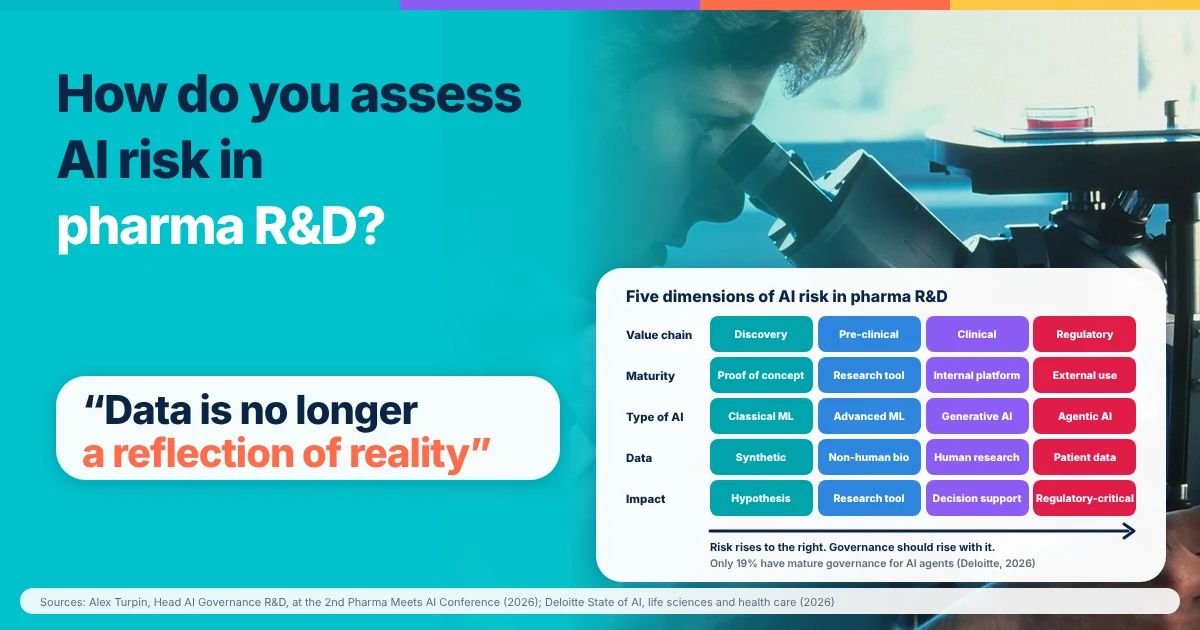
The second reason is that R&D itself is not one place. To judge how much governance a project needs, he proposed five questions, and the point of the exercise is that no single answer is enough.
The first question is where in the value chain the model is used. In discovery, AI helps generate hypotheses and inform scientists, and the decisions it influences have low impact because everything will be tested again. In pre-clinical work the aim is to be sure of a hypothesis before testing it in humans, so the tolerance for error falls. In clinical development AI helps generate the evidence itself, for example by stratifying patients or selecting sites. In regulatory and safety work that evidence has to be defended, and in manufacturing the model has to be robust at scale. The same algorithm becomes more consequential at each step.
The second question is how mature the project is. Most AI work in R&D begins as an exploratory proof of concept: one dataset, one team, often retrospective, with no intention of turning it into a product. Some of these become validated research tools with reproducible pipelines and an expert in the loop. A few become platforms used across therapeutic areas, which need access approvals, monitoring and regular updates. Very few are deployed outside the company, embedded in a diagnostic or in a solution that affects the patient pathway, and those need the full weight of data, AI and cyber governance. A project's risk grows as it climbs, even if the model inside it does not change.
The third question is what kind of AI it is, because each generation brought its own weakness. Classical machine learning, such as regression or random forests, is interpretable but can be too simple for complex tasks. Deep learning handles images and text at scale but is less transparent and can drift. Generative models can produce molecules, summaries and synthetic data, and they can also hallucinate. Agentic systems can carry out whole pieces of work on their own, which makes their behaviour hard to predict and usually calls for a human in the loop.
The fourth question is what data the model runs on, and here he was most specific. Synthetic data looks safe but still inherits the risks of the data it was generated from. Non-human biological data, such as omics, cell assays and animal models, raises little privacy concern but a great deal of scientific uncertainty. Human research data from trials, biomarkers and imaging is highly sensitive, regulated and limited in how it can be reused. Real-world patient data from health records, claims, wearables and registries carries the highest privacy risk and the most complicated questions of consent and jurisdiction. He called it the biggest concern.
The fifth question is how much regulatory and ethical weight the output carries. A model may only suggest hypotheses, it may serve as a research tool, it may support a decision, or it may be critical to a regulatory outcome.
Placed side by side, the five answers form a map. A project that sits early in the value chain, at the proof-of-concept stage, using a classical model on non-human data to suggest hypotheses, is in the low-risk corner and can be left to move quickly. A project that uses an agentic system on patient data to support a decision in clinical development is in the opposite corner. His conclusion was that governance intensity should increase as a project gets closer to patient data, to decisions and to regulation, and that it has no reason to be the same everywhere.
The map would be easier to use if the technology stood still, but two shifts in the last few years have moved many projects towards the high-risk side. The first is a shift in who uses AI. Classical models were tools for statisticians, and deep learning was for data scientists and research scientists, so governance could concentrate on data quality, bias, robustness and validation. Generative AI put models in the hands of everyone in the organisation. Governance now has to deal with content risk, intellectual property, misuse and the way people behave with the tools. Agentic AI goes a step further, because the system itself pursues a goal and executes tasks. At that point the questions are about decision boundaries, levels of autonomy, accountability and impact on patients.
The second shift is less obvious and, in Turpin's presentation, more important. It concerns what AI does to data. Until recently, data was something a company collected, and governance asked where it came from and whether it could be trusted. With generative AI, data is also created, in the form of synthetic and augmented datasets, and it becomes increasingly difficult to tell real from generated. With agentic AI, the system acts on that data, its actions can influence what happens to patients, and those outcomes become new real data that feeds the next decision. His slide summed up the consequence in one line: "Data is no longer a reflection of reality".
This is why he argued that governance can no longer stop at the origin of the data. It has to cover how data is created, how it is used when a system takes decisions on its own, and how it is reinforced over time through feedback loops. It is also why his first takeaway was that agentic AI changes the governance paradigm, from validating a model once to constraining an autonomous system continuously, with guardrails, logging and human oversight.
Surveys published in 2025 and 2026 suggest that the industry has not yet solved the problem the map is meant to address. Most AI in pharma still does not scale, and governance is the reason companies give most often. In a ZS survey of 115 US pharma and biotech technology executives, only 40% of pilots reached scaled deployment, and 68% named weak data quality and governance as a top cause of AI failure, ahead of unclear objectives (67%) and lack of business ownership (63%). Bain reached a similar result from a different angle: in its survey of 133 life sciences executives, only 20% of organisations were consistently deploying AI at scale (Bain, June 2026, consultancy).
The gap is widest for the newest technology. In Deloitte's 2026 survey, 72% of life sciences and health care respondents expected to use agentic AI within two years, yet only 19% said they had a mature governance model for autonomous agents (Deloitte, March 2026, 378 respondents, consultancy). Scientists feel the same lack of footing. Half of the respondents in a Pistoia Alliance poll named the absence of shared verification standards as the biggest barrier to AI agents in research (Pistoia Alliance, December 2025, industry consortium, sample size not stated), and standards are only starting to arrive: the US standards body NIST launched an AI Agent Standards Initiative in February 2026.
There is also evidence that companies which take governance seriously get more out of AI, although it has to be read with care. Gartner's survey of 360 organisations found that those which regularly audit and assess their AI systems were more than three times as likely to achieve high value from generative AI (Gartner, November 2025). An IBM study of 2,000 technology executives reported that organisations which build control into their AI systems deploy 16 times as many agents as those relying on manual governance, with fewer incidents (IBM, June 2026, vendor). McKinsey found CEO oversight of AI governance to be one of the elements most correlated with bottom-line impact (McKinsey, March 2025). All three are correlations from self-reported surveys, so they show that governance and value tend to appear together, not that one causes the other.
Finally, the people who will use the results expect proof. In the American Medical Association's 2026 survey of 1,692 physicians, 81% used AI, up from 38% in 2023, and 88% rated validation of safety and efficacy as important (AMA, March 2026). Adoption among clinicians is no longer the obstacle. Trust in what the tools produce is.
Regulators have arrived at the same idea of proportionality from their side. In January 2026 the EMA and FDA published ten guiding principles of good AI practice in drug development. They ask for AI that is human-centric by design, a risk-based approach, adherence to standards, a clear context of use, multidisciplinary expertise, data governance and documentation, sound model design and development, risk-based performance assessment, life cycle management, and clear, essential information. Two of these, the risk-based approach and the context of use, are in effect the regulators' version of a risk map: they ask the sponsor to say what the model is for and to match the evidence to the consequences.
The principles build on earlier steps. The EMA's 2024 reflection paper already tied the level of scrutiny to patient risk and regulatory impact, and in March 2025 the agency qualified its first AI tool, a locked model for reading liver biopsies in trials. In the United States, the FDA's January 2025 guidance on AI to support regulatory decisions is built on a risk-based credibility framework for a defined context of use. It was still listed as a draft when we checked.
Manufacturing shows how unsettled the details still are. The draft EU GMP Annex 22, consulted on in 2025, would allow only static models in critical applications and says generative models should not be used there. After a workshop in mid-2026, the EMA reported that the comments it received favoured allowing generative AI under a documented, risk-based control strategy, and added a caution that fits Turpin's argument closely: human oversight cannot compensate for inadequate validation (EMA, October 2026). No final text had been confirmed when we checked.
The EU AI Act adds one more layer, although a thinner one than many R&D teams expect. The Act does not apply to AI developed and used solely for scientific research and development, which is why much early work sits outside it. Its high-risk obligations now apply from 2 December 2027 and 2 August 2028 after the 2026 amendment (White & Case, August 2026, law firm). How far the research exemption reaches has not been settled officially (Pinsent Masons, August 2025, law firm), so a project that starts as pure research and later moves towards a product may cross into scope along the way.
Knowing where a project sits on the map is only useful if it changes what the team has to do. Turpin described a toolkit of six elements and was clear that not every project needs all of them at full strength. Data catalogues tell a team what data exists, who owns it and how it may be used. Model registries record every version of a model together with its training data and performance, and experiment logging keeps track of who ran what, with which data and parameters. Together these three give the traceability that science has always demanded. Guardrails and boundaries define what an AI system can and cannot do, which matters most for agents that have access to tools. Human oversight can take two forms: a person in the loop who approves each action, or a person on the loop who monitors and can intervene. The sixth element, the risk assessment, decides how much of the rest applies. In his words: "Not every project needs full Governance — but every use case needs some governance."
Patient data is where the toolkit is applied in full. For any tool that touches it, he listed the conditions he considers the minimum. The tool needs formal approval from IT security and may only use models that have been vetted internally. Access is controlled and logged. The architecture is secure, with private networking and encryption. Retrieval is limited to approved repositories, with access control at document level and defences against prompt injection. Documents uploaded by a user stay isolated in that user's session. Prompts and uploads are never used to train models, even internally. And uploaded documents are deleted automatically after a set retention period.
Read together, the map and the toolkit describe a gradient. At the low end, teams experiment freely, on the condition that runs and data access are logged automatically. Further up, reproducible pipelines, access controls and drift monitoring are added. At the top, where a system affects patients or a regulatory decision, full testing and validation apply. The effort goes where the risk is, which is what allows the low-risk majority of projects to move fast.
For the evaluation side of the same problem, see How Do You Evaluate Generative AI in Pharma? 2026 Guide.
These topics will be on the agenda at the 3rd Pharma Meets AI Conference in Barcelona on 19–20 April 2027, organised by UBIQ Events.
Enterprise AI mostly affects productivity and business decisions. R&D AI generates knowledge that can affect patient safety, regulatory outcomes and scientific conclusions, so errors travel further and are harder to detect.
A way of placing each AI project by several factors at once so that governance can be proportionate. The map presented at our conference uses five: value chain stage, maturity and deployment, type of AI, nature of the data, and regulatory and ethical impact.
Real-world patient data, such as health records, claims, wearables and registries. It carries the highest privacy risk and the most complex consent and jurisdiction questions. Synthetic data is lower risk but still inherits risk from its source.
Generative AI creates data that can be hard to distinguish from real data. Agentic AI takes actions that produce new data and can influence outcomes, creating feedback loops. Governance has to cover how data is created and used, and what autonomous systems are allowed to do.
The Act does not apply to AI developed and used solely for scientific research and development. How far that exemption reaches in practice has not been settled officially, and AI used beyond pure research can fall within scope.
Their joint principles, published in January 2026, ask for a human-centric design, a risk-based approach, a clear context of use, data governance and documentation, risk-based performance assessment and life cycle management, among others.
The Pharma Meets AI Conference, organised by UBIQ Events, brings together R&D, data science, IT and commercial leaders. The 3rd edition takes place in Barcelona on 19–20 April 2027.


