Key takeaway
Around half of patients stop or skip self-injected therapies. The reasons we heard on our stage, what published studies say about them, and how strong the evidence is that connected injection devices and companion apps help.
Short answer: Dr. Saurabh Bhavsar, Director, Program Manager Digital Health at Ypsomed, a maker of self-injection devices, gave his answer at the 5th Digital Health Conference in October 2025: "Patients skip injection because the therapy isn’t yet designed around their reality. Connected devices and digital companions help close that gap." Published studies support the first sentence well. Forgetting, fear of needles, thin training and treatment fatigue are all documented, and in large studies about half of patients stop or skip self-injected therapies. The second sentence is promising but less proven. Connected injectors record high adherence among patients who keep using them, yet many stop using the device, and no randomised trial has so far tested a connected autoinjector with adherence as its endpoint.
Dr. Saurabh Bhavsar, Director, Program Manager Digital Health at Ypsomed, gave a keynote on the second day of the 5th Digital Health Conference in Madrid in October 2025. His company makes injection devices and the connected add-ons and software that go with them, so he spoke as a supplier with a product in this field. What made the talk useful beyond that was its starting point. He did not open with a device. He opened with the dose that is prescribed, dispensed and paid for, and then never taken. His slide called it "A dose that never happened!"
He set out what is lost each time: "Each missed dose can mean disease flare-ups, avoidable hospital visits, and wasted therapy cost." The scale, as he put it, is that "Every year, millions of injections that should have been taken… aren’t". And he connected the clinical loss to the commercial one in four words on the same slide: "poor outcome→ lower reimbursement". A medicine that works in the trial and is skipped at home will look worse in the real-world data that payers increasingly use.
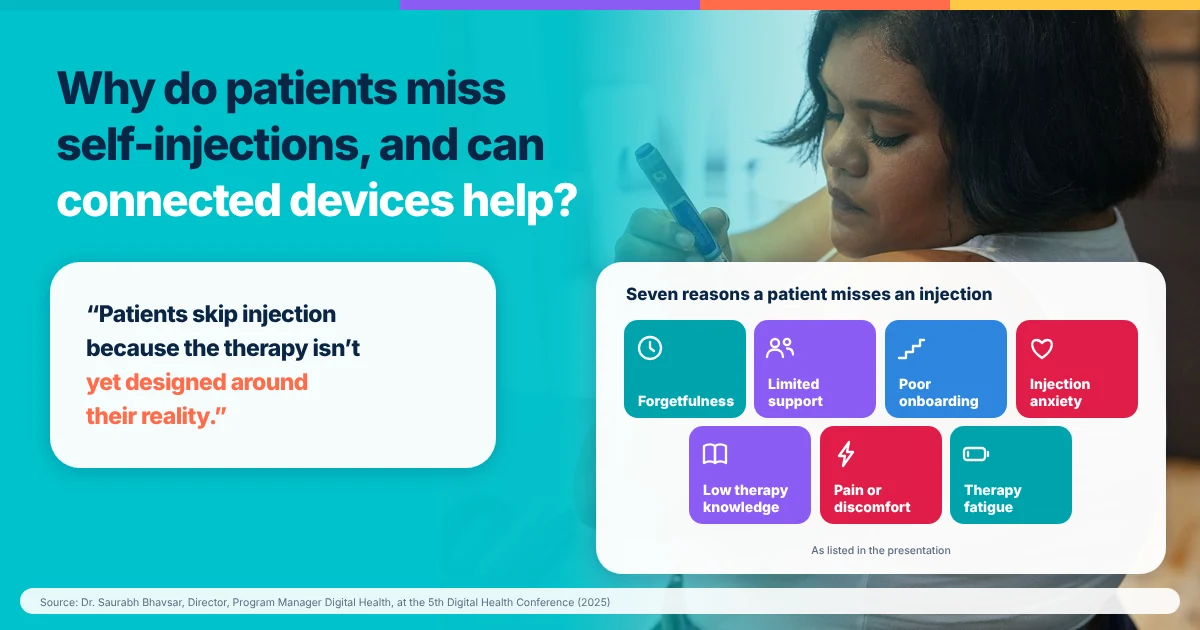
His next question was why. In his presentation there are seven reasons an injection is missed: forgetfulness, limited support, poor onboarding, injection anxiety, low therapy knowledge, pain or discomfort, and therapy fatigue. None of them is about the molecule. They are about a person alone at home with a device, often weeks after the single training session, and his summary of the list was the sentence this article started with:
"Patients skip injection because the therapy isn’t yet designed around their reality. Connected devices and digital companions help close that gap."
He then matched each problem with a digital answer, under the heading "From missed to managed". For forgetfulness, smart reminders and calendar integration. For poor onboarding, guided support and real-time feedback during the injection. For low therapy knowledge, education and self-management. For injection anxiety and therapy fatigue, behavioural engagement, transparent injection logs and therapy tracking, and "personalized insights and adaptive interventions". For limited support, care coordination, which means that the nurse or doctor can see the same record the patient sees.
The technical idea behind all of this is simple. A sensor on or in the injector registers that an injection took place and sends the time and result to an app. In his words, this "enhances data quality by automatically capturing objective injection data", and the same platform can serve a clinical trial first and the marketed product later.
The best-known figure is old and general. In 2003 the World Health Organization concluded that in developed countries only about half of patients with chronic diseases take their treatment as prescribed. That covered every kind of long-term medicine. More recent studies of injectables point the same way.
For biologics, a meta-analysis published in 2024 pooled 66 studies with 136,619 patients with rheumatoid arthritis and put adherence to biologic medicines at about 45%. The spread between individual studies was very wide, from 12% to 99%, which shows how much depends on the patient group and on how adherence is measured.
The largest recent numbers come from GLP-1 medicines for diabetes and obesity, most of which are weekly injections. In a study of 125,474 US adults with overweight or obesity published in JAMA Network Open in 2025 (reported by Healio, trade press), 54% had stopped within one year and 72% within two. Among people without diabetes, 65% had stopped within a year. An analysis of 5,780 insured adults by the US pharmacy benefit manager Prime Therapeutics in June 2025 found that only one in twelve was still on a GLP-1 for obesity after three years. Cost, side effects and supply all contribute to these figures, so they are not a pure measure of difficulty with injecting. They do show how far real use falls below what a clinical trial assumes.
Two of the seven reasons from the stage have been measured carefully. The first is fear. A review of 119 studies (McLenon and Rogers, Journal of Advanced Nursing, 2019) estimated that 20% to 30% of young adults are afraid of needles, and found that 16% of adult patients had avoided a flu vaccination for that reason. Someone who avoids one injection a year is unlikely to find a weekly one easy.
The second is onboarding. In a US survey from 2022 of 264 patients who self-inject biologics and 277 healthcare professionals, funded by a maker of training devices, about half of the professionals said they give a single training session. Fewer than a third of trained patients had practised with a training device in front of a professional. Nine in ten patients remembered at least one negative experience in their first six months, and more than a third were not confident that they were injecting correctly. Read together with the speaker's list, this suggests that "poor onboarding" and "limited support" are the reasons a company can most directly change.
The published results look impressive at first. In multiple sclerosis, where electronic injectors have been used the longest, a 2023 analysis of 2,644 users of one such device in 20 countries found a mean adherence of 91.7%. In diabetes, a Swedish study of a connected insulin pen (2020), funded by the manufacturer, found that missed mealtime doses fell by 43% once patients and their clinics could see the injection data.
Three cautions apply. First, almost all of this evidence comes from studies without a comparison group, paid for by the company that makes the device. A systematic review of connected insulin pens (2023) found ten studies, of which only two were randomised trials, with 16 and 80 participants. We found no randomised trial of a connected autoinjector that used adherence as its endpoint.
Second, a device can only record the patients who keep using it. In the multiple sclerosis analysis, the average patient used the device for 1.35 years and only 9.1% used it for the full three years. In a study of 13,553 children on growth hormone (2020) using a connected injector, the share with good adherence fell from 87% to 65% over four years. High adherence among those who stay may partly reflect who stays.
Third, the companion app has its own adherence problem. A meta-analysis of 17 studies of apps for chronic disease (2020) found that 43% of users dropped out, and a 2025 review of digital adherence tools reported that five of nine app trials showed no significant effect on adherence.
What a connected device does reliably is the thing the speaker described last: it captures objective injection data. That is valuable on its own terms. In a trial it replaces a paper diary. In routine care it tells a nurse which patient has stopped, in time to call. Whether the patient then injects more regularly depends on what happens after the data arrives, which is a question about the support service around the device.
The regulatory route is now clear for the hardware. In August 2025 the FDA cleared a connectivity add-on for an autoinjector, the product from the speaker's company and by its own account the first of its kind, as an "injection data capture device". The classification is telling: the device is cleared to record, and it is not indicated to treat or diagnose anything.
The software is where the rules have tightened. On 20 October 2026 the FDA finalised its guidance on prescription drug use-related software, which covers companion apps supplied by the drug's sponsor. What such an app shows the patient is treated as drug labelling, and a claim that the app improves outcomes needs evidence of a meaningful improvement in a clinical outcome. A sentence like "helps you stay on therapy" therefore has to be earned with a study. The FDA's final guidance on cybersecurity in medical devices (June 2025) applies to any injector that transmits data.
In the EU, a drug delivered in an integral device needs a CE certificate or a notified body's opinion for the device part under Article 117 of the Medical Device Regulation, and whether the app is itself a medical device is decided under the software guidance MDCG 2019-11, revised in June 2025.
Payers follow the same logic as the slide that read "poor outcome→ lower reimbursement". Germany, which had 58 reimbursed digital health applications listed at the end of 2025, is tying part of their price to measured results (Bitkom, industry association report, 2026). A companion that cannot show an effect will be hard to get paid for separately.
Start from the list of reasons, as the speaker did, and ask which of them your patients actually have. A weekly obesity injection in a motivated adult and a daily injection in a child with a chronic condition fail for different reasons, and a reminder helps only where forgetting is the cause. Interviews and a small observational study with the plain device will say more than a feature list.
Fix onboarding whether or not the device is connected. The survey evidence suggests that a second training session and supervised practice are still missing for many patients, and neither needs electronics. A connected device adds the ability to see who is struggling in the first weeks, which is when most negative experiences happen.
Decide what the data is for before collecting it. If nobody is assigned to act when a patient misses two doses, the log changes nothing. The studies with the best results placed the data in front of a clinic or a nurse service. That service, its staffing and its consent model belong in the business case next to the hardware.
Plan the evidence early. With app content now treated as labelling in the US and outcome-linked pricing arriving in Germany, the companion needs its own study with a comparison group and a clinical endpoint. Using the connected device in the pivotal or a late-phase trial, as the speaker suggested with one platform "from Clinical to Commercial", is the cheapest moment to collect it.
In the US, comments on the FDA's revised draft guidance on the essential performance characteristics of drug delivery devices, which includes an appendix on autoinjectors, close on 28 January 2027 (FDA, October 2026). In the EU, the European Commission is due to adopt key implementing acts for the European Health Data Space in March 2027, ahead of the first exchange of patient summaries and prescriptions in March 2029, which will shape how injection data can be shared with clinicians.
The market itself is also moving. Two oral GLP-1 medicines for weight management reached the US market between December 2025 and April 2026 (AJMC, trade press). If a share of patients moves from a weekly injection to a daily pill, the largest group of new self-injectors will shrink, and the adherence question will follow them to a different form.
The 6th Digital Health Conference, organised by UBIQ Events, took place in Barcelona on 3 and 4 November 2026. Dates for the next edition will be announced on the conference website.
Roughly half in many settings. In a study of 125,474 US adults starting a GLP-1 medicine, 54% had stopped within one year. A 2024 meta-analysis put adherence to biologics in rheumatoid arthritis at about 45%, with a very wide range between studies.
The reasons named on our stage were forgetfulness, limited support, poor onboarding, injection anxiety, low therapy knowledge, pain or discomfort, and therapy fatigue. Studies confirm that needle fear affects 20% to 30% of young adults and that many patients receive only one training session.
It is an injection device, or an add-on that clips onto one, with a sensor that registers each injection and sends the time and result to an app. The patient, and with consent the care team, can then see an objective record of doses taken and missed.
Possibly, but the proof is limited. Users who keep using connected injectors show adherence of around 85% to 90% in manufacturer-funded studies without a comparison group. Many stop using the device over time, and no randomised trial of a connected autoinjector with adherence as the endpoint has been published.
Yes. In the US, FDA guidance finalised in October 2026 treats what a sponsor's app shows the patient as drug labelling, and claims of benefit need clinical outcome evidence. In the EU, the app may itself be a medical device, depending on what it does.
Which reasons for missed doses apply to its own patients, how good the initial training is, who will act on the injection data, and whether a study with a comparison group can show a change in a clinical outcome.
The Digital Health Conference, organised by UBIQ Events, brings together digital health, medical, commercial and R&D leaders from pharma and medtech companies across Europe.