Key takeaway
The same doctor often exists under several spellings in several pharma systems. Why AI agents and omnichannel engagement fail on that data, what master data management does about it, and what GDPR and disclosure rules already require.
Short answer: Sebastian Sbirna, Data Governance Lead – Global Data & AI at Novo Nordisk, gave the reason in one line at the 2nd Pharma Meets AI Conference in April 2026: "To deliver superior customer engagement, we need to know our customers". An AI agent or an omnichannel campaign can only act on the customer record it is given, and in most companies the same doctor exists under several spellings in several systems. Master data management fixes that. In his words, it "is the process of consolidating and maintaining a single, high-quality record for customers, products, suppliers etc. within a business by integrating data from various sources. This unified master data provides a reliable and consistent foundation for accurate reporting, error reduction, elimination of redundancy and informed decision-making."
Sebastian Sbirna, Data Governance Lead – Global Data & AI at Novo Nordisk, gave a keynote on the first day of the 2nd Pharma Meets AI Conference in Barcelona. He spoke in a personal capacity: his presentation stated that the opinions were his own and not necessarily those of his employer. At a conference about AI, he chose to talk about the least glamorous layer underneath it, the record a company keeps of each healthcare professional (HCP) and healthcare organisation (HCO) it works with.
He began with the state of AI governance in the industry. His presentation described it in three phrases: "Highly complex and fragmented governance", "Focus is on legal and regulatory compliance rather than people and business needs" and "Narrow focus on ML, rather than Agentic AI future". The last one matters because of what agents do. In his presentation, work before agents is a person extracting data, requesting what is missing, analysing and reporting. After agents, the person writes a prompt and the agents carry out those same four steps. Every one of them touches customer data, so the agent is only as good as the record it reads.
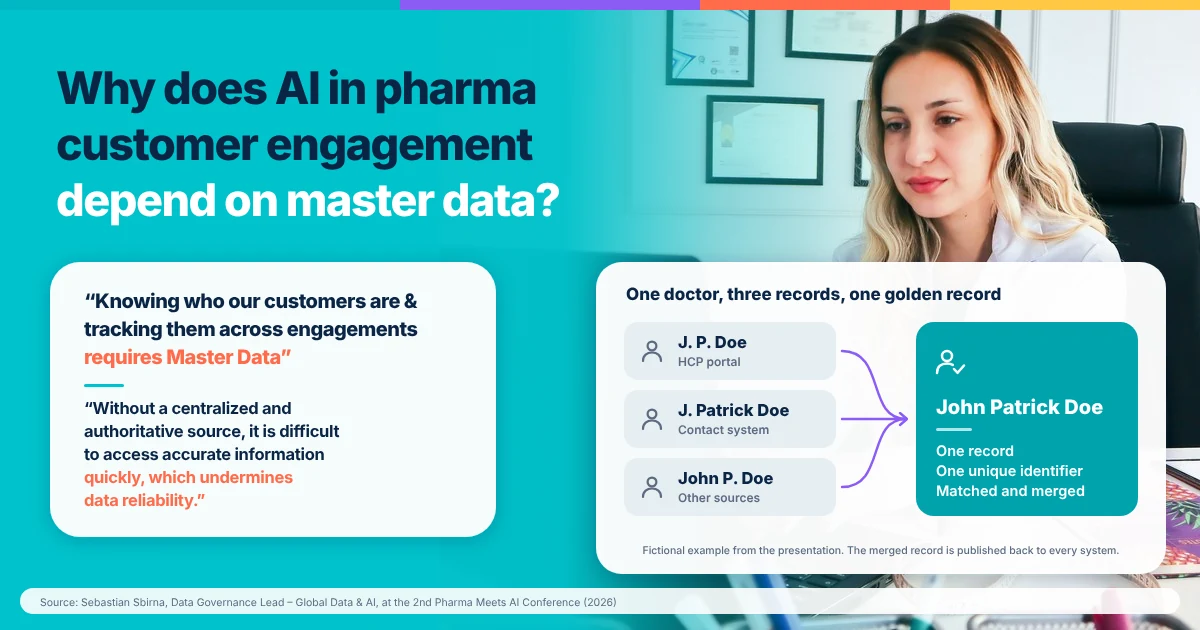
He then showed what that record looks like in practice with a fictional doctor. The doctor is registered in one system as "J. P. Doe", in a second as "J. Patrick Doe" and in a third as "John P. Doe", with the address written differently in each. To a person these are obviously one man. To a database they are three customers. A master data management system takes in all three, matches and merges them, and publishes one record, "John Patrick Doe" with one address and one unique identifier, back to the customer relationship system, the email platform and every other system that needs it. He summed up the point of the exercise in one sentence: "Knowing who our customers are & tracking them across engagements requires Master Data".
He asked the audience to picture the alternative from the user's chair:
"Imagine being a user of our internal HCP engagement systems… You may find duplicate profiles or missing essential data while searching for HCP information. This can lead to lengthy investigations to locate accurate records and track down missing details from other parties."
The consequence, as his presentation put it: "Without a centralized and authoritative source, it is difficult to access accurate information quickly, which undermines data reliability."
A second example showed that the merged record is also a richer one. The directory used to select medical experts knows a doctor's tier and fair market value. The finance system knows the same doctor's tax and invoice details. Neither knows what the other holds until master data management connects them, after which each system sees the complete profile and changes made in one place are synchronised to the other.
The last part of the talk was about keeping the record true, and here the answer was people. In his presentation, data stewards open the data quality tool every week to check flagged errors, work through the queue of possible duplicates to match and merge, and correct errors in the source systems where they arose. Quality is measured on six dimensions: completeness, validity, consistency, accuracy, uniqueness and timeliness. His conclusion was that "Data flows must be enforced through Data Governance to sustain quality", and that all of this is groundwork: "We’re building the future for advanced Customer Engagement models" by "laying the foundations for master data management".
Master data is the small set of records that many systems share: customers, products, suppliers. Master data management is the discipline of keeping one agreed version of each. The result is often called a golden record, which IBM (a vendor) defines as a single source of truth that integrates data from various sources. For a pharma company the customer master holds each healthcare professional and organisation once, with a stable identifier that every other system uses.
The six quality dimensions that the speaker's stewards measure are not a house invention. They come from a 2013 paper by the UK chapter of the data management association DAMA, and the UK government's Data Quality Hub still uses them. Uniqueness, the dimension that the fictional Dr Doe fails, means that nothing is recorded more than once.
Most companies do not build this record alone. They buy reference data on healthcare professionals from specialist providers and match it against their own. That became easier in August 2025, when the two largest suppliers to the industry, IQVIA and Veeva, ended their long legal dispute and agreed that each company's data can be used inside the other's software, including Veeva's master data product.
A model has no way of knowing that two records are one person. A next-best-action engine that sees three Dr Does divides one doctor's history between them, so each looks like a lightly engaged customer and each may receive the same email. An agent asked how often the company met its top experts last year will give an answer that is wrong in proportion to the duplicates. The error is silent, because every individual record looks valid.
The figures suggest this is the normal condition. Gartner predicted in February 2025 that through 2026 organisations will abandon 60% of AI projects that are not supported by AI-ready data, and found in a survey of 1,203 data management leaders that 63% either lack the right data management practices for AI or are unsure whether they have them. In April 2026 the same firm reported that organisations with successful AI initiatives spend up to four times more, as a share of revenue, on foundations such as data quality and governance.
Pharma-specific numbers come mainly from vendors and should be read with that in mind, but they agree with each other. In a Veeva survey of 116 senior commercial leaders published in October 2025, 96% said their data is not well structured or ready for AI at scale, 72% said they spend up to 100 days matching healthcare professional data across sources, and 71% did not believe generative AI alone can fix data quality. In a Salesforce survey of 400 life sciences leaders from September 2025, 97% agreed that trusted data is essential for AI agents to be effective.
Independent evidence that the same doctor looks different in different databases comes from the US. A research letter in JAMA (2023) compared five large insurers' directories and found that, of 449,282 physicians listed in more than one, 81% had inconsistent address or specialty information.
Doctors notice the result. In a survey of 225 senior clinicians in the UK, the US and Germany by the agency Graphite Digital (reported by pharmaphorum, trade press, February 2026), 58% said pharma's digital content feels repetitive or irrelevant and 52% said they receive too many emails or messages. A Deloitte survey from March 2025 (consultancy research) found that only 28% of healthcare professionals said pharma engagement meets their needs, while 82% of pharma executives were satisfied with it.
The speaker's presentation made the compliance case in one line: "Accurate and reliable HCP/HCO data ensures compliance with regulations such as GDPR, EFPIA, and the Sunshine Act". Each of the three depends on knowing exactly who a person is.
Under the GDPR, a doctor's name, address and specialty are personal data like anyone else's. Article 5 requires personal data to be "accurate and, where necessary, kept up to date", and Article 16 gives every person the right to have inaccurate data about them corrected without undue delay. A company that holds one doctor in four systems has to find and correct all four, which is only practical when they are linked. The same link makes it possible to apply the access controls the presentation asked for, "allowing only the right people to access sensitive HCP/HCO data".
Disclosure rules add a deadline. Under the EFPIA Code, member companies publish their payments and other transfers of value to healthcare professionals and organisations by 30 June of the following year. Where a professional has not consented to being named, the amount moves into an aggregate figure, so the company must know which payments belong to which person and what that person has agreed to. In the US, the Open Payments programme published 17.07 million records worth $14.67 billion for 2025, and the regulation behind it sets penalties of up to $1.15 million a year for failures to report (42 CFR 403.912). A payment booked against the wrong Dr Doe is a reporting error in both regimes.
The EU AI Act adds less than many expect. Marketing and customer engagement are not among the high-risk areas listed in Annex III, so most engagement AI will fall outside the strictest tier. What does apply, since 2 August 2026, is the transparency duty in Article 50: people must be told when they are interacting with an AI system. An AI agent that writes to or chats with a doctor has to say what it is.
The order of work follows from the talk. Before funding another engagement model or agent, count how many systems hold healthcare professional records and how many identifiers one doctor can have. If the answer is more than one, that is the first project, and it can be justified on compliance grounds alone.
Ownership comes next. A master data platform without stewards is a one-off clean-up, and the record starts to drift the following week as doctors move, retire and change specialty. The practice described on our stage is modest and repeatable: named stewards, a weekly review of flagged errors and possible duplicates, corrections made in the source system so the error does not return, and quality reported on the same six dimensions every time.
Measure before promising. The share of records that are complete and unique is a number a commercial leader can understand, and it tells an AI team in advance how far to trust any output built on that data. It is also a fairer test of readiness than a pilot, which usually runs on a hand-cleaned sample.
Finally, treat governance as something that makes new uses possible. The speaker's criticism of the industry was that governance changes only when legislation forces it. A trusted customer record is the opposite case: built once for compliance, it is what allows omnichannel engagement and agents to be tried safely.
The disclosure calendar is fixed: 30 June 2027 is the publication date for 2026 payments under the EFPIA Code and in the US Open Payments programme. In the UK, the government decided in December 2025 not to make disclosure of industry payments a legal duty for now and to issue non-statutory guidance instead, which has no publication date yet. The European Commission's proposal of November 2025 to simplify parts of the GDPR is still in negotiation and is not expected to be adopted before 2027 (Heuking, law firm). And the AI Act's obligations for high-risk systems in the areas listed in Annex III, moved by the 2026 amendment, apply from 2 December 2027.
The 3rd Pharma Meets AI Conference, organised by UBIQ Events, takes place in Barcelona on 19 and 20 April 2027.
It is the discipline of keeping one agreed, high-quality record for each shared entity, above all each healthcare professional and healthcare organisation, by matching and merging the versions held in different systems and publishing the result back to all of them under one identifier.
It is the single trusted profile of one doctor that results from merging every variant of that doctor's record across systems. It carries one unique identifier, and other systems read from it instead of keeping their own version.
A model cannot tell that two records describe the same person. If one doctor appears several times, an AI agent or recommendation engine splits that doctor's history, repeats messages and reports wrong totals. Gartner predicted that through 2026, 60% of AI projects not supported by AI-ready data will be abandoned.
Completeness, uniqueness, timeliness, validity, accuracy and consistency. They were defined by DAMA UK in 2013 and are widely used to measure and report data quality.
Disclosure of payments to healthcare professionals, under the EFPIA Code in Europe and Open Payments in the US, requires each payment to be attributed to the right person. Duplicate or mismatched records lead to payments reported against the wrong person or missed.
Marketing and customer engagement are not among the high-risk areas listed in Annex III of the Act. The transparency duty in Article 50 does apply: people must be informed when they interact with an AI system.
The Pharma Meets AI Conference, organised by UBIQ Events, brings together data, AI, commercial, medical and R&D leaders from pharma companies across Europe. The 3rd edition takes place in Barcelona on 19 and 20 April 2027.