← All insights
Pharma Commercial

How Should Pharma Plan a European Launch in 2026?

UBIQ Events
·
October 22, 2026
How Should Pharma Plan a European Launch in 2026?

Key takeaway

Europe's new pharma rules reward fast development and filing, while patients still wait a median 532 days for new medicines. Launch teams that build their evidence and access plans before approval launch faster and wider.

Short answer: Plan for Europe as a sequence, not a single launch. The new EU Pharma Package ties part of your exclusivity to how fast you develop and file, joint EU health technology assessments are expanding, and patients still wait a median 532 days for new medicines. Teams that build their evidence and access plans before approval launch faster and wider.

Key takeaways

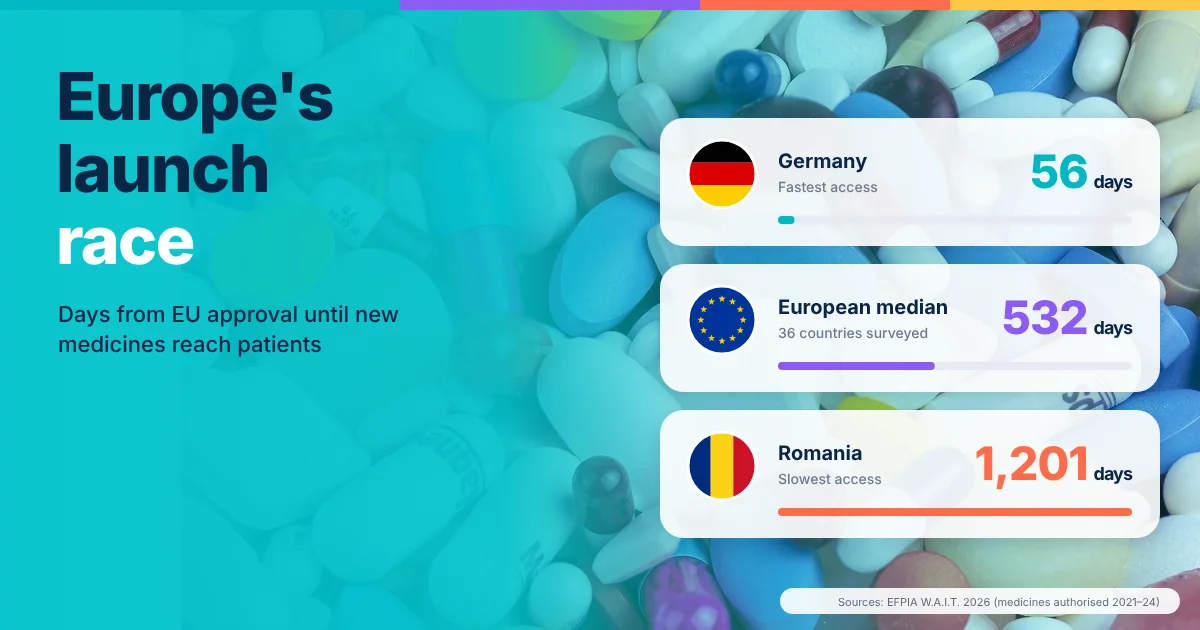
  • New medicines took a median of 532 days to become available across Europe, from 56 days in Germany to 1,201 in Romania (EFPIA W.A.I.T. report, May 2026).
  • The EU Pharma Package sets 8 years of data protection plus 1 year of market protection, with up to 2 extra years for new indications or development criteria such as comparative trials (Taylor Wessing, March 2026).
  • Orphan exclusivity becomes 9 years as standard and 11 years for breakthrough orphan medicines (Taylor Wessing).
  • EU joint clinical assessments have applied to new cancer medicines and advanced therapies since 12 January 2025, and extend to orphan medicines in 2028 (European Commission).

What does the EU Pharma Package change for launches?

The Council adopted the Pharma Package in autumn 2026, and the European Parliament must still formally adopt it before publication (ECA Academy, October 2026). The new Regulation is expected to apply about two years after publication (Taylor Wessing).

  • Regulatory data protection: 8 years, the baseline exclusivity before generics can file.
  • Market protection: 1 year, plus 1 more for a new indication with significant clinical benefit. Plan indication expansion early.
  • Development extension: 1 more year for criteria such as comparative trials or timely EU filing. Comparative data now earns exclusivity, not just access.
  • Orphan exclusivity: 9 years standard, 11 for breakthrough orphans, plus 1 year per new orphan indication (maximum 2). Rare-disease portfolios need indication roadmaps.
  • Bolar exemption: now covers HTA, pricing and reimbursement and tender work by generics during patent life. Expect generic competitors to be launch-ready on day one of expiry.
  • Antimicrobial voucher: a transferable 1-year data protection voucher for priority antimicrobials, a new asset to value and trade.

Source: Taylor Wessing (March 2026).

Why does launch timing still differ so much across Europe?

Approval is European, but pricing and reimbursement remain national. EFPIA's 2026 W.A.I.T. survey of 168 medicines across 36 countries found a median 532 days from EU approval to availability, with an 88% gap in access between countries (LexisNexis summary of the EFPIA report). A medicine can be prescribable in Germany within two months and wait more than three years in Romania.

How do joint clinical assessments change evidence planning?

Under the EU HTA Regulation, a joint clinical assessment now reviews the clinical evidence for new cancer medicines and advanced therapy medicinal products, applying since 12 January 2025. Orphan medicines join in January 2028 and all new medicines in January 2030 (Regulation (EU) 2021/2282). Countries still decide on value and price, but the clinical comparisons are set once, at EU level, early. That makes comparator choice and trial design a commercial decision years before launch.

What this means for launch teams

  • Sequence markets deliberately. Lead with fast-access markets such as Germany, and prepare dossiers for slower ones in parallel.
  • Design trials for exclusivity and HTA at once. Comparative trials can now earn an extra year of protection and feed joint clinical assessments.
  • Choose comparators early. Joint clinical assessments fix the clinical comparison at EU level, so comparator choice becomes a commercial decision years before launch.
  • Plan the indication roadmap early. New indications extend protection, especially in rare diseases.
  • Prepare for faster generic entry. The wider Bolar exemption lets generics complete HTA, pricing and tender work before your protection ends.

What to watch in 2027

  • Formal adoption of the Pharma Package by the European Parliament and publication in the Official Journal.
  • January 2028: orphan medicines enter EU joint clinical assessments.
  • National transposition: member states must bring the new Directive into national law.
  • EFPIA W.A.I.T. 2027: whether time to availability starts to fall.

Sources

  1. LexisNexis. (2026). EFPIA publishes annual WAIT report. lexisnexis.co.uk (accessed 22 October 2026)
  2. Taylor Wessing. (2026). The 2026 Pharma Package: a new regulatory framework for medicinal products in the EU. taylorwessing.com (accessed 22 October 2026)
  3. ECA Academy. (2026). EU Pharma Package: Council adopts new rules. gmp-compliance.org (accessed 22 October 2026)
  4. European Commission. Implementation of the Regulation on health technology assessment. health.ec.europa.eu (accessed 22 October 2026)
  5. Regulation (EU) 2021/2282 on health technology assessment.

Header photo: Myriam Zilles on Unsplash.

Frequently asked questions

What is the EU Pharma Package?

The EU Pharma Package is a new Regulation and Directive replacing EU medicines legislation. It changes regulatory protection periods, orphan exclusivity, the Bolar exemption and incentives for antimicrobials. The Council adopted it in autumn 2026, and formal adoption by the European Parliament is pending.

How long is regulatory data protection under the new EU rules?

The baseline is 8 years of data protection plus 1 year of market protection. One more year is possible for a new indication with significant clinical benefit, and another for development criteria such as comparative trials, the so-called 8+1(+1+1) model.

How long does it take for new medicines to reach patients in Europe?

EFPIA's 2026 W.A.I.T. report found a median of 532 days from EU approval to availability for medicines authorised in 2021–24, ranging from 56 days in Germany to 1,201 days in Romania.

What is an EU joint clinical assessment?

It is a single EU-level review of the clinical evidence for a new medicine under the HTA Regulation. It has applied to cancer medicines and advanced therapies since January 2025, and extends to orphan medicines in 2028 and all new medicines in 2030.

Where can I discuss launch excellence with industry leaders?

The Pharma Commercial Innovation Summit, organised by UBIQ Events, brings together pharma commercial leaders to discuss launch excellence, market access, omnichannel engagement and AI in commercial.

Join the discussion in person

Pharma Commercial Innovation Summit

Visit the conference